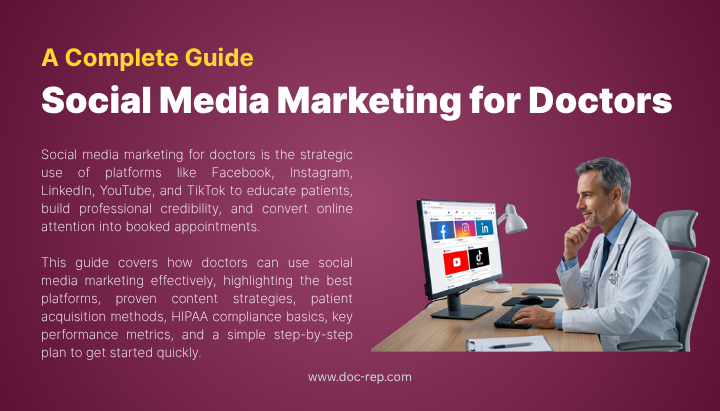
Facebook marketing for doctors is a patient acquisition and brand-building strategy that uses Meta platforms, including Facebook Business Pages, Ads Manager, and Reels, to attract, engage, and convert patients.
Facebook marketing helps doctors find new patients, build trust, and grow their practice using free posts and paid ads. Nearly 280 million people in the U.S. use Facebook each month. Over 3 billion people use it worldwide. That makes it one of the biggest places where patients look for and pick their doctors.
This guide walks you through the complete Facebook marketing system for doctors, from setting up and optimizing your page to creating high-performing content, launching compliant ad campaigns, tracking results, and avoiding costly mistakes that limit patient acquisition.
Why Should Doctors Use Facebook Marketing?
Doctors should use Facebook because their patients already spend time there. Over 82% of U.S. adults have a Facebook account. Nearly 40% of social media users find new products and services on Facebook, according to Sprout Social. Healthcare is not an exception.
Patients check out doctors online before booking a visit. They read reviews. They look at practice pages. They watch health tips in their feed. A strong Facebook page makes your practice feel known and trusted before anyone calls your office.
Three clear benefits stand out:
- Reach local patients directly: Facebook lets you show your ads only to people in your zip code, age group, or interest area. A kids’ doctor in Austin can reach parents within 10 miles. A skin doctor can target adults over 35 who follow skincare pages. No billboard gives you that level of control at the same price.
- Build connection before the first visit: Health tips, short videos of your team, and patient stories (with signed consent) make people feel like they already know you. This makes them more likely to book and less likely to skip the visit.
- Track every dollar: Facebook shows you exactly how many people saw your post, clicked your link, or filled out a form. You can see your cost per lead down to the penny. Then you can shift your budget to what works best.
How Does Facebook Marketing Work for Medical Practices?
Facebook marketing works through two paths: organic content (free posts, Reels, Lives, and Stories) and paid ads (posts you pay to show to a chosen group). Both depend on Meta’s system, which picks what shows up in each person’s feed.
Meta’s Andromeda update, fully live in 2025, uses AI to rank content. It looks at three things: how useful the post is, how fresh it is, and how much real talk it sparks (comments, shares, and replies). Posts that get people talking in the first 24 hours reach far more users.
For doctors, this means a plain “Book now” image will barely show up. But a short video about “3 signs you need to see a skin doctor” will reach many more people. The system rewards posts that teach, help, or start a real chat.
Here is how both paths fit together. Free posts build your name and keep current patients close. Paid ads bring in new patients who have never heard of you.
Organic Facebook Marketing for Doctors
Organic means every post, video, Reel, or Live you put out without paying. It costs no money, just your time. But it needs a steady plan.
Free reach for business pages has dropped a lot since 2018. Referral traffic fell over 75% for many pages. But organic posts still matter. They prove your practice is active and real when a new person checks your page after seeing an ad or Googling your name.
Setting Up and Optimizing Your Facebook Page
A complete Facebook Business Page works like a second website for your clinic. Fill in every field: your practice name, address, phone, hours, services, and a link to book visits online.
Use your logo or a good headshot as your profile photo. Pick a cover image that shows your clinic, your team, or a warm, friendly space. Write a short “About” section with your field, your city, and a clear next step like “Call us today” or “Book online.”
Turn on the “Book Now” or “Send Message” button. Link your page to Instagram so you can share content on both apps. List your services so patients can browse them right on Facebook.
What Type of Content Should Doctors Post on Facebook?
Doctors should post helpful, easy-to-relate-to content that answers the questions patients ask most. The Andromeda system pushes posts that get comments, saves, and shares. So your content should invite people to react.
Here are the types that work best:
- Short Reels (under 90 seconds): Meta’s October 2025 update now shows 50% more Reels from creators who posted that same day. Reels under 90 seconds get top spots in both the Feed and Reels tab. A skin doctor filming a 45-second Reel on “What SPF really means” will reach far more people than a flat image with the same info.
- Health tip carousels: Posts with many images and numbered tips (like “5 Foods That Help Lower Blood Pressure”) get people to swipe, which counts as longer time spent on your post.
- Behind-the-scenes content: Show your team, your waiting room, or a quick walk through your office. This makes your practice feel human. It also eases the worry some patients feel about seeing a new doctor.
- Myth-busting posts: “TRUE or FALSE: You only need sunscreen on sunny days.” Posts like this get comments and shares because people love to tag friends or debate.
- Patient stories (with signed HIPAA consent): Video stories from real patients build strong trust. Always get written consent first. Never show any private health details.
Stay away from posts that only sell (“20% off this week!”). The system pushes these down. Mix helpful content with light promotion instead.
How to Use Facebook Live for Patient Engagement
Facebook Live creates a real-time talk with viewers. The system treats live video as top content while the broadcast runs. Doctors can host Q&A sessions on common health topics, explain a treatment, or welcome a new provider to the team.
Keep Live sessions between 15 and 30 minutes. Tell your followers about it 2 to 3 days before through a post and a Story. Pick a quiet, well-lit room. Have a team member read out comments so you can reply on camera.
Key rule: Never talk about a real patient’s case during a Live. Keep every topic general. A heart doctor can explain “what happens in a stress test.” But they should never mention any patient’s results.
What Is the Best Time to Post on Facebook for Doctors?
The best time for healthcare pages is weekdays from 9 a.m. to 1 p.m. local time. Monday through Thursday gives the best results (Sprout Social, 2026).
Here are the top windows from Sprout Social’s healthcare data:
- Monday and Tuesday: 10 a.m. to 1 p.m.
- Wednesday: 9 a.m. to 1 p.m. and 3 to 4 p.m.
- Thursday: 8 a.m. to 12 p.m. and 4 p.m.
- Friday: 10 to 11 a.m. and 6 p.m.
Weekends show a big drop for healthcare pages. But Hootsuite’s 2025 data for health and pharma says 11 a.m. to 1 p.m. on Saturdays can also work, based on your crowd.
Test both weekday and Saturday windows. Check Facebook Insights to see which days and times work best for your page.
Pages that post 3 to 5 times per week see about 5x more action per post than pages that post now and then. Staying regular matters more than being perfect. Four posts a week beats one “perfect” post a month.
Facebook Ads for Doctors
Facebook ads let doctors reach people beyond their current followers. You pick who sees your ads by age, location, interests, and more. For clinics that want a steady flow of new patients, paid ads are now a must.
Organic reach of Facebook has dropped recently, so you need paid ads for steady results. The good part: Facebook gives you targeting tools that no other ad platform can match for local doctors.
How to Define Your Practice Goals Before Running Ads
Every ad campaign needs a clear goal. Without one, you waste money on likes and views that never turn into booked visits.
Here are common goals for clinics:
- Get new patients: You want people who have never been to your clinic to book their first visit. Use lead or traffic campaigns for this.
- Fill spots for a service: You have open slots for TMS services, dental implants, or yearly check-ups. Use time-based offers with tight targeting.
- Let a new area know you exist: You just opened a second office or moved to a new spot. Brand awareness campaigns work best here.
Pick the Facebook goal that fits. For new patients, choose “Leads” or “Traffic.” For awareness, pick “Reach” or “Video Views.” Keep in mind that Meta’s 2025 health ad rules now block some lower-level goals for health-related ads. You may need to use goals like Landing Page Views or Reach instead.
How to Build the Right Target Audience
Facebook lets you choose who sees your ads by location, age, gender, and interests. For doctors, the most key filter is location.
Most clinics pull patients from a 5- to 15-mile area. Set your radius to match. A bone and joint clinic in the suburbs that targets a 30-mile range wastes money on people who will never drive that far.
Add more filters on top of location:
- A kids’ dentist targets parents aged 25 to 45 within 8 miles.
- An OB-GYN targets women aged 18 to 40 nearby.
- A heart doctor targets adults 50 and older within 12 miles.
Facebook also lets you pick people by interest (fitness fans, healthy eaters, parents). But you cannot target by health conditions like diabetes, heart disease, or mental health. Meta’s rules ban this.
Lookalike audiences also help. Upload a list of current patient emails (no health data attached). Facebook will find new users who look like your patients. This helps you reach people who are likely to book.
Creating Engaging and Compliant Ad Creatives
The effective Facebook ads for doctors use a strong image, a clear benefit, and a simple next step. They also follow Meta’s Health and Wellness ad rules and HIPAA.
What works:
- A video of a doctor talking to the camera about a common worry (“Is it normal to feel tired all the time?”)
- A carousel ad showing your different services
- A single photo of your team with text like “Now taking new patients in [City].”
What to avoid:
- Before-and-after photos (Meta often blocks these for medical ads)
- Claims like “We cure back pain” or any promise of results
- Any image or text that names or hints at a health condition
- Patient photos without signed, written consent
Keep your ad text short. Start with the problem. Show your clinic as the answer. End with a clear step: “Book your free visit,” “Call us today,” or “Send us a message.”
Why Mobile Optimization Matters for Medical Ads
Over 98% of U.S Facebook users open the app on a phone, according to a report by Statista. If your ad leads to a slow or hard-to-use website on mobile, you lose that patient right away.
Every page linked from a Facebook ad must load in under 3 seconds on a phone, look good on a small screen with no side-scrolling, and have a “Call Now” button plus a short form near the top.
Real-world example: A TMS clinic sent ad clicks to a page built for desktop. Over 80% of mobile visitors left at once. After consulting with us at DOC-REP, they rebuilt the page for phones with a big “Call Now” button and a 3-field form; their leads went up 3x.
Always test your pages on a few phone types before running any ad. A great ad that leads to a bad phone page is wasted money.
Organic vs Paid Facebook Marketing: Which Should Doctors Choose?
Doctors should use both organic and paid Facebook marketing. Neither works as well on its own. Free posts build trust. Paid ads bring in new faces. Together, they form a full system.
| Factor | Organic (Free) | Paid Ads |
| Cost | Free (just your time) | Needs a budget ($500+/month to start) |
| Reach | Small and shrinking each year | You control the size |
| Speed | Slow, takes months to grow | Fast, leads can start in days |
| Trust | Great for showing you are real | Works best when paired with organic |
| Targeting | Only reaches followers and their friends | Targets any group by age, area, or interest |
| Long-term value | Builds over time like a savings account | Stops when you stop paying |
| Best use | Keep patients close, build your name | Get new patients, push services |
Best Facebook Strategy for Doctors (Combined Approach)
The best plan gives each path a clear job.
- Free posts: Share 3 to 5 times a week. Mix Reels, tips, team photos, and patient stories. Reply to every comment and message within 24 hours. The Andromeda algorithm tracks this. Your free content acts as proof when someone clicks a paid ad and checks out your page.
- Paid ads: Run steady lead campaigns aimed at your local area. Add short-term campaigns for timely needs (flu shots in fall, allergy help in spring). Show follow-up ads to people who visited your site but did not book.
- How they connect: A person sees your ad and clicks. Then they check your Facebook page. If your page looks active and helpful, they feel good about booking. If your last post was six months ago, they leave. Paid ads get the click. Free content closes the deal.
Facebook Advertising Compliance for Healthcare
Health ads on Facebook must follow both Meta’s own rules and federal privacy laws. Breaking them can get your ad account shut down. It can also bring HIPAA fines that reach millions of dollars.
What Are Meta’s Advertising Policies for Medical Content?
Meta bans medical ads that make false claims, target people by health conditions, or make viewers feel bad about their bodies. In 2025, Meta added a Health and Wellness ad group with strict limits on how health ads track results.
Key limits include:
- You cannot target by health conditions (diabetes, depression, cancer, etc.)
- No before-and-after photos that suggest a sure outcome
- No claims of cures or exact results
- Prescription drug ads need written approval from Meta first
- Health-related tracking events face more limits under the new tier system
Meta placed doctor visit ads under the restricted group. This means you often cannot use deep tracking goals like “Lead” or “Purchase.” You may need to use simpler goals like Landing Page Views, Reach, or Engagement.
These limits turn on by themselves based on your business type and landing page. You cannot turn them off.
HIPAA Considerations for Facebook Marketing
Meta does not sign a Business Associate Agreement (BAA). This means the platform is not set up to handle Protected Health Information (PHI). Every medical practice must know this before doing any Facebook marketing.
PHI is any mix of a patient’s personal data (name, email, IP address, device ID) with their health data (diagnosis, treatment, history). The standard Meta Pixel grabs IP addresses, device IDs, page URLs, and form entries. On a medical site, this can create PHI without you knowing it.
What you must do:
- Never share patient names, health details, or visit info through Facebook
- Take the Meta Pixel off any page with health-specific content (symptom pages, treatment info, booking forms)
- Use server-side tracking through a HIPAA-safe tool if you need conversion data
- Never build audiences using patient health data
- Get signed, written consent before using any patient’s photo, name, or story
What you can do safely:
- Run ads about general wellness and your practice hours
- Target by age, area, and broad interests (fitness, parenting, healthy living)
- Use Meta’s Conversions API through a safe data layer that strips personal info before sending it to Meta
- Share health tips that do not name any patient
How Much Does Facebook Advertising Cost for Doctors?
Facebook ads for doctors cost an average of $2.05 per click and around $50 per lead i, based on our campaign data from working with 3 medical practices.
- Average CTR: 3.20%
- Average Conversion Rate: 4.75%
These metrics place medical advertising in a higher-cost bracket compared to most industries.
For context:
- All-industry average CPC: $1.92
- All-industry average CPL: $27.66
This means doctors typically pay ~80% more per lead than the average business on Facebook, reflecting higher competition and patient acquisition complexity.
Average Budget Benchmarks for Medical Facebook Ads
Using our average $50 cost per lead, here’s what realistic monthly budgets look like:
- 20 leads/month → ~$1,000/month
- 50 leads/month → ~$2,500/month
These are lead generation costs, not booked patients.
Most clinics convert 20% to 40% of leads into actual visits.
So to acquire 20 new patients, you typically need:
- 50–100 leads/month
- Estimated budget: $2,500–$5,000/month
Important Note
Actual costs can vary significantly depending on:
- Location (city vs. rural, competition level)
- Geographic targeting (local vs. multi-location campaigns)
- Medical specialty (e.g., dermatology, psychiatry, elective procedures tend to cost more)
Your campaign performance will ultimately depend on targeting precision, offer quality, and conversion systems, not just ad spend.
How to Start Small and Scale Your Ad Spend
Start with $500 to $1,000 per month. This gives you enough data to test without risking too much.
- Week 1 to 2: Launch 2 to 3 ad versions with different images and headlines. Aim at your local area. Set $15 to $25 per day for each ad set.
- Week 3 to 4: Check your numbers. Pause any ad with a cost per click above $4 or a click rate below 1.5%. Put more money behind your best ad.
- Month 2: Add a follow-up campaign for people who visited your site. Test a video ad against your best static ad.
- Month 3 and on: Grow winning ads by raising the daily budget 20% at a time. Add new groups. Run season-based campaigns.
One key rule: never double your budget in one day. Facebook’s system needs time to adjust. Small, steady raises keep your cost per lead stable.
How to Track and Optimize Facebook Marketing Performance
Tracking turns guesses into facts. Without it, you cannot tell which ads bring patients and which waste your money. Watch these numbers in order of value:
- Cost Per Lead (CPL). What you pay for each person who fills out a form, sends a message, or calls. This is your top money metric.
- Conversion Rate (CVR). The share of people who click your ad and then take action. Below 3% means your landing page needs fixing.
- Click-Through Rate (CTR). The share of people who see your ad and click. Below 1% means your ad or targeting needs work.
- Return on Ad Spend (ROAS). Say a new patient is worth $1,500 in year one. You spend $47.47 per lead. About 30% of leads book. Your cost per new patient is roughly $158. That is a solid return.
- Engagement Rate (for free posts). Likes, comments, shares, and saves show how your organic posts perform. More action tells the system to show your posts to more people.
Using Facebook Pixel and Conversion Tracking
The Facebook Pixel is a small bit of code on your website. It tracks what visitors do (page views, form fills, button clicks) and reports it back to Facebook. For medical sites, setting up the Pixel needs careful HIPAA thought.
The safe way to set it up:
- Do not put the standard Meta Pixel on pages with health info (symptom guides, treatment pages, booking forms).
- Use server-side tracking through Meta’s Conversions API (CAPI) with a safe data layer that removes personal info before it goes to Meta.
- Track broad events like “Page View” instead of health-specific ones like “Visit Booked.”
- Work with a HIPAA-safe tracking tool that signs a BAA and handles data for you.
Even with these limits, you can still get enough data to make smart choices. Track page views, link clicks, and general form fills without sending private data.
How to Improve Campaigns Based on Performance Data
Check your ads every week. Change one thing at a time so you know what helped or hurt.
- If CPL is too high: Try new groups, shrink your area, or switch from a photo to a video ad.
- If CTR is low: Swap your headline, use a better image, or change the first line of your ad text.
- If CVR is low: Fix your landing page. Make the headline stronger. Cut form fields. Add trust points (doctor degrees, star rating). Make the action button bigger.
If organic engagement is low: Post more Reels (they get top reach). Ask questions in your captions. Reply to every comment to boost the system’s score.
Facebook Marketing vs Google Ads for Doctors: Which Is Better?
Facebook and Google serve different parts of the patient journey. Google catches patients who are looking for a doctor right now. Facebook reaches people before they start looking, so your name is on their mind later.
Neither is always “better.” The right pick depends on your goals, budget, and how you get patients.
When Should Doctors Use Facebook Ads?
Use Facebook ads when you want to build local awareness, promote elective or cosmetic services people do not search for, stay visible to future patients, show follow-up ads to site visitors who did not book, or launch a new office.
Facebook is great at making people want something they were not yet looking for. A patient may not search for a diet coach today. But a Facebook ad about “5 Signs Your Food Is Making You Tired” plants a thought. When they keep feeling tired, they think of your clinic.
When Should Doctors Use Google Ads Instead?
Use Google Ads when you want to catch patients with a need right now. Someone typing “urgent care near me” or “knee surgeon in Dallas” has strong intent. Google puts your practice at the top of those results.
Google often turns more leads into real patients because the intent is higher. Facebook got more clicks and more leads at a lower cost per click. But Google leads were far more likely to book and pay.
Google works best for urgent care, primary care, and procedures with high search volume (dental implants, LASIK, joint work). It also fits clinics in crowded markets where SEO alone takes too long.
Can Doctors Use Both Platforms Together?
Yes. This is the best approach for most practices. Use Facebook for the top of the funnel (building awareness) and Google for the bottom (catching people ready to book).
How it works together: Facebook ads show your practice to local people through helpful content and doctor intro videos. Those who visit your site but do not book see follow-up ads on Facebook. At the same time, Google Ads catch people searching for your field. A person who saw your Facebook ad last week and then searches “skin doctor near me” is more likely to click your Google listing because they know your name.
Start with a 60/40 budget split based on your main goal. Need patients fast? Put more into Google Ads for doctors. Building a long-term brand? Put more into Facebook. Check the data after 90 days and adjust.
5 Common Mistakes Doctors Make with Facebook Marketing
The biggest mistake is treating Facebook like an old-school newspaper ad: post once in a while, run a bland ad, and ignore the rules. Here are the five most common errors.
- Posting on and off: Many clinics post for two weeks, then go quiet for months. The system punishes gaps. When you come back, your reach starts near zero. Commit to at least 3 posts a week, or hold off until you can keep up. Batch-make your posts once a month to stay ahead.
- Putting the Meta Pixel on health pages: Placing the standard Meta Pixel on every page of your medical site is risky. The Pixel grabs page URLs, IP addresses, and device IDs. On a page about heart disease or a booking form, this data becomes PHI. The fix: remove the Pixel from health-specific pages now. Use server-side tracking with a safe data layer.
- Boosting posts instead of using Ads Manager: The “Boost Post” button is fast. But boosted posts give you weak targeting, no A/B testing, and poor results next to ads built in Ads Manager. A dollar in Ads Manager does more than a dollar in a boost.
- Targeting too wide: A mental health clinic running ads to “everyone 18 to 65 within 25 miles” wastes a lot of money. Narrow your group. A tighter crowd of 20,000 to 100,000 people will almost always beat a wide crowd of 500,000.
- No clear next step: Every ad must tell the viewer what to do: call, book online, send a message, or visit the site. Ads without a clear call to action get views but not patients.
How to Start Facebook Marketing: Step-by-Step Action Plan
Follow these steps to get Facebook marketing running for your practice in 30 days.
- Days 1 to 3: Set up your page: Create your Facebook Business Page. Fill in every field. Add your logo, cover photo, phone number, website, and service list. Turn on the “Book Now” button.
- Days 4 to 7: Plan your content: Map out your first month. Aim for 4 posts a week: one Reel, one health tip carousel, one team or office photo, and one patient-focused post (FAQ, story with consent, or myth-buster). Make them all in one sitting.
- Days 8 to 10: Check your compliance: Look at your website for Meta Pixel placement. Remove it from any page with health-specific content. Set up server-side tracking if needed. Review every planned post for HIPAA issues. Write a social media policy for your staff.
- Days 11 to 14: Start posting: Publish your planned content. Reply to every comment and message within 4 hours during work hours. Watch Facebook Insights for early data.
- Days 15 to 20: Run your first ads: Open a Facebook Ads Manager account (not the Boost button). Build your first lead or traffic campaign. Target your local area by age, gender, and interest. Set $15 to $25 per day. Launch 2 to 3 ad versions to test.
- Days 21 to 30: Check and adjust: Look at your ad results after 7 to 10 days. Turn off poor ads. Put more budget on the best one. Keep posting organic content. Set up a 30-minute weekly check to review numbers and plan next month.
Is Facebook Marketing Enough for Patient Acquisition for Doctors?
The answer depends on your urgency and goals. If your focus is brand awareness and steady, low-intent patient acquisition, Facebook marketing alone can be enough.
If you want faster growth and more consistent patient flow, then no. Facebook marketing is only one part of a broader patient acquisition system. It plays a strong role in awareness and lead generation, but relying on it alone limits scalability and consistency.
For a more complete acquisition strategy:
- Instagram marketing for doctors helps expand reach, build trust through visual content, and engage younger demographics.
- Google Ads for doctors captures high-intent patients actively searching for treatments, making it essential for direct patient acquisition through PPC.
In practice, Facebook works best when combined with other channels to create a multi-touch patient journey rather than acting as the sole acquisition source.
Final Thoughts
Facebook marketing gives doctors a clear, trackable way to reach more patients in their area. Its mix of sharp targeting, huge user base, and many content types makes it one of the best tools for clinic growth when used the right way.
The key is using free and paid efforts together. Free posts build the trust patients look for before they choose a new doctor. Paid ads bring the reach and lead flow that free posts cannot match in today’s system.
Start simple: a full page, steady content, and a small ad budget. Put compliance first at every step. Track your numbers. Reply to your crowd. Let data shape your choices.
The clinics that win on Facebook are not the ones with the most money. They are the ones that show up every week, share real value, and treat each reply as a chance to earn trust.

Atiur Rahman
Atiur Rahman is a ROI focused healthcare branding and growth marketing expert with 12 years of experience helping doctors and medical practices attract qualified patients. He builds data driven marketing systems that increase visibility, strengthen reputation, and drive measurable revenue growth.