Digital marketing for doctors is the strategic use of websites, medical SEO, Google Business Profile optimization, online reviews, and paid search to attract and convert patients. In 2026, a practice without strong search visibility, a mobile-friendly website, and consistent reputation signals is invisible during high-intent patient searches.
Healthcare demand is massive. Approximately 7% of all daily Google searches are health-related, equal to nearly 70,000 queries every minute. These are patients actively searching for symptoms, specialists, and appointments. Digital visibility is not a promotion; it is direct patient access.
Today’s patients research and compare before booking. They assess credentials, read reviews, and evaluate clarity before making contact. Digital marketing addresses two essential challenges for medical practices: being found and being trusted.
This 7-step strategy guide is written for doctors who are thinking about digital marketing, planning to start, or hesitating about how to begin this journey. It’s built from real-world experience with medical practices, not theory, to help you understand the process, avoid costly mistakes, and make informed decisions.
Step 01: Understand Patient Digital Behavior First
Understanding patient digital behavior is the foundation of effective digital marketing for doctors. Patient search behavior in healthcare follows urgency, symptom awareness, referral validation, and insurance constraints. High-intent searches such as “cardiologist near me,” “knee pain specialist,” or “pediatrician accepting new patients” signal readiness for appointment booking rather than casual browsing.
Digital marketing for doctors requires mapping patient intent stages: symptom research, provider comparison, reputation evaluation, and booking action. Younger demographics prioritize mobile search, online scheduling, Google reviews, and website speed. Older demographics prioritize board certification, years of experience, hospital affiliations, and insurance acceptance.
Specialty determines behavior patterns. Orthopedic practices attract pain-driven urgent searches. Mental health clinics attract privacy-sensitive evening searches. Pediatric clinics attract safety-focused parent-driven research. Geographic context modifies urgency; urban patients compare multiple practices, while rural patients prioritize proximity and availability.
Accurate patient persona development aligns website messaging, SEO keyword targeting, Google Ads campaigns, and social media positioning. Behavioral analysis converts traffic into booked appointments and reduces marketing waste.
Step 02: Build a Patient-Focused Medical Website
A patient-focused medical website is the central conversion asset in digital marketing for doctors. It functions as a 24/7 patient acquisition platform with search visibility, authority validation, and secure booking capability.
A high-performing medical website includes:
- Service pages optimized for condition-based keywords
- Physician bio pages with board certification, education, and hospital affiliations
- Online scheduling with HIPAA-compliant integrations
- Insurance verification information
- Clear location schema markup for local SEO
- SSL encryption and data security compliance
Website performance metrics directly affect patient conversion. Load speed under three seconds improves engagement. Mobile-first responsive design supports over 60% of healthcare searches conducted on smartphones. Structured data markup improves Google indexing and local pack visibility.
Effective medical website design prioritizes clarity over aesthetics. Clear call-to-action buttons (“Book Appointment,” “Call Now”), readable typography, and professional clinical imagery increase patient trust and reduce bounce rates.
In digital marketing for doctors, the website is not branding collateral; it is a measurable revenue infrastructure.
Step 03: Invest in Local SEO
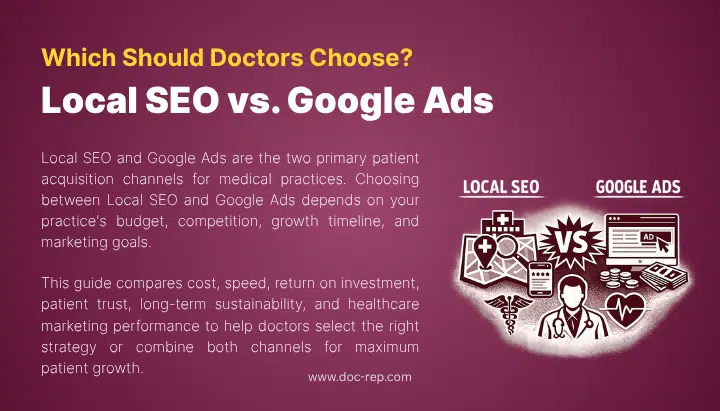
Local SEO is the systematic optimization of search engine visibility within a defined geographic service area. It determines whether your practice appears in Google’s Local Pack, Google Maps results, and location-based organic rankings.
Core components of medical local SEO include:
- Google Business Profile optimization: Accurate NAP (Name, Address, Phone) consistency, service categories, appointment links, and weekly update posts improve local relevance signals.
- On-page local keyword targeting: Service pages optimized for “dermatologist in [city],” “family doctor near me,” and specialty + location combinations increase search match precision.
- Medical citation management: Consistency across directories such as Healthgrades, Zocdoc, Vitals, and hospital systems strengthens trust signals.
- Review velocity and sentiment analysis: Google’s ranking algorithm weighs recency, review volume, and average rating. Ongoing review generation influences both ranking and conversion.
Healthcare SEO operates under Google’s YMYL (Your Money or Your Life) standards. Demonstrating E-E-A-T (Experience, Expertise, Authoritativeness, Trustworthiness) through physician credentials, structured authorship, and medically reviewed content strengthens long-term ranking stability.
Local SEO for doctors produces compounding visibility growth and reduces long-term patient acquisition cost.
Step 04: Use Social Media Strategically
Social media marketing for doctors strengthens credibility, community visibility, and patient familiarity. It does not replace SEO or website conversion systems; it reinforces authority signals and perceptions of trust.
Platform alignment by specialty:
- Facebook: Local community engagement, primary care visibility, patient education updates
- Instagram: Visual brand positioning, clinic environment transparency, physician accessibility
- LinkedIn: Professional authority building, referral network expansion, hospital partnerships
- YouTube: Long-form educational content, procedure explanations, patient expectation management
Medical social media content categories should include:
- Condition education posts
- Preventive care awareness campaigns
- Clinic updates and staff introductions
- FAQ video explanations
- Public health observances
Posting consistency (2–3 times weekly) in social media increases algorithmic reach. HIPAA compliance requires zero patient identifiers, documented consent for testimonials, and no personalized medical advice in comments.
Strategic medical social media builds familiarity before first contact, increasing booking confidence and referral reinforcement.
Step 05: Run Google Ads for Faster Patient Acquisition
Google Ads for doctors is a paid search acquisition strategy that positions medical practices at the top of high-intent search results instantly. It accelerates patient flow while organic SEO matures.
Medical Google Ads campaign structure includes:
- Service-specific keyword clusters
- Geographic radius targeting
- Negative keyword filtering
- Dedicated landing pages per treatment
- Call tracking and conversion measurement
High-intent examples include:
- “urgent care near me,”
- “orthopedic surgeon consultation,”
- “same day pediatric appointment.”
Medical cost-per-click (CPC) ranges from $3 to $60+ depending on specialty and location based on our experiences. ROI depends on conversion rate optimization, booking funnel clarity, and staff responsiveness to inquiries.
Compliance requirements include adherence to Google healthcare advertising policies, restricted pharmaceutical categories, and truthful claim substantiation.
When structured properly, Google Ads for doctors lowers time-to-patient acquisition and produces measurable return on ad spend (ROAS).
Step 06: Build and Protect Your Online Reputation
Online reputation management for doctors directly influences patient trust, local SEO rankings, and booking conversion rates. This influence is not theoretical. According to the American Medical Association,83% of consumers searching for healthcare say online reviews play an essential role in their decision-making process. In practical terms, your review profile is often evaluated before your website, and sometimes before your credentials.
Primary review platforms include:
- Google Reviews
- Healthgrades
- Zocdoc
- Vitals
- RateMDs
Ranking impact factors include:
- Review quantity
- Review recency
- Average star rating
- Keyword presence in reviews
A compliant review generation system should include post-visit requests via HIPAA-compliant messaging tools. Incentivized reviews violate platform policies and risk listing suspension.
Response strategy:
- Thank positive reviewers publicly
- Respond to negative reviews professionally without confirming patient status
- Flag policy-violating reviews through platform moderation channels
Reputation management ensures clinical quality is accurately reflected online and prevents misinformation from distorting patient perception.
Step 07: Track Performance and Make Data-Driven Decisions
Analytics for digital marketing for doctors transforms marketing from expense to measurable growth system.
Core tracking infrastructure includes:
- Google Analytics 4 for user behavior and conversion tracking
- Google Search Console for keyword performance and indexing health
- Google Business Profile Insights for local discovery metrics
- Call tracking software for phone attribution
- CRM integration for patient acquisition cost calculation
Primary KPIs for medical practices:
- Cost per patient acquisition (CPA)
- Conversion rate (appointments ÷ website visitors)
- Local keyword ranking position
- Review growth rate
- Return on ad spend (ROAS)
Monthly analytics review identifies underperforming service pages, inefficient ad groups, and high-converting traffic sources. Data-driven adjustments improve marketing ROI and reduce wasted budget allocation.
Practices that track performance systematically outperform competitors relying on assumptions..
Final Words
Digital marketing for doctors is not about doing everything at once. It is about executing the right steps in the right order. Understand how your patients search and make decisions. Build a clear, fast, mobile-friendly website that earns trust.
Optimize your local SEO and fully complete your Google Business Profile. Maintain a consistent, professional presence on the platforms your patients use. Implement a structured system for generating and responding to reviews.
Once this foundation is solid, use Google Ads to accelerate patient acquisition while organic visibility compounds. Track performance consistently, measure what drives appointments, and refine based on real data.
Clarity, consistency, and disciplined execution separate growing practices from invisible ones. The practices that win are the ones patients can find, understand, and trust before the first call is ever made.

Atiur Rahman
Medical & Healthcare SEO Expert focused on turning search visibility into booked patients and revenue. Specialties: technical SEO, schema and LLM visibility, AI SEO/GEO, and local search for clinics.