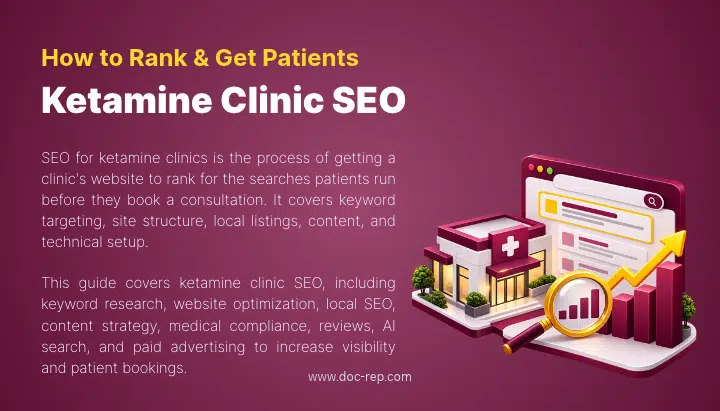
SEO for ketamine clinics is the process of getting a clinic’s website to rank for the searches patients run before they book a consultation. It covers keyword targeting, site structure, local listings, content, and technical setup.
Ketamine clinic SEO is harder than typical local-business SEO. Google treats it as YMYL content (“Your Money or Your Life”), meaning pages get extra scrutiny for accuracy and trust before they rank. Add regulatory limits on medical claims and a high-cost, high-consideration treatment, and generic SEO advice stops working.
Patients also research longer before booking. SEO fits into that research phase: a patient searches a symptom or condition, compares clinics and treatment types, then books. A clinic that shows up only at the “near me” stage misses the earlier research traffic that builds trust first.
This guide covers ketamine clinic SEO, including keyword research, website optimization, local SEO, content strategy, medical compliance, online reviews, AI search, and paid advertising to attract more patients through organic search and increase consultation bookings.
Why Does SEO Matter for Ketamine Clinic Growth?
SEO matters for Ketamine therapy clinics because it builds a traffic source that keeps working after you stop paying for it, unlike ads. A ranked page keeps sending visitors weeks or months after you publish it. Paid ads stop the moment you stop the campaign.
Ketamine treatment also costs more out of pocket than most local services (IV sessions typically run in the hundreds of dollars per visit, and insurance rarely covers them). Patients weighing that cost read multiple pages before calling: clinic credentials, safety protocols, condition-specific information, and reviews.
Organic content is where that research happens, and it reads as more trustworthy than an ad because the patient found it through their own search.
| Factor | SEO | Paid Ads |
|---|---|---|
| Cost pattern | Upfront time investment, lower cost per visit over time | Ongoing cost per click, stops when budget stops |
| Speed to results | Weeks to months | Immediate |
| Trust signal | Feels earned to the patient | Feels promotional |
| Best use | Long-term patient acquisition | Bridging traffic while SEO builds |
How Do You Choose the Right Keywords for a Ketamine Clinic?
The right keywords match what patients actually type at each stage of deciding on treatment, not just the treatment name. Group them by intent so your content plan covers the full research path.
Condition and Treatment Keywords
These target the condition itself: depression, treatment-resistant depression, PTSD, anxiety, chronic pain. Each deserves its own page, not a single paragraph buried in a general services page.
Local Intent Keywords
These pair the service with location: “ketamine clinic near me,” “ketamine therapy [city].” These convert fastest because the searcher is close to booking.
Comparison and Research Keywords
These cover decisions patients make before choosing a clinic: ketamine vs. Spravato, cost, safety, side effects. This is where accurate, well-sourced content matters most, since patients are comparing options and checking claims.
| Keyword type | Example | Funnel stage |
|---|---|---|
| Condition | “ketamine therapy for PTSD” | Awareness |
| Comparison | “ketamine vs Spravato cost” | Research |
| Local | “ketamine clinic Bethesda MD” | Ready to book |
Actual search volume varies by city and changes month to month, so pull current numbers from Google Keyword Planner or a paid tool like Ahrefs before finalizing a list. Don’t guess at volume; it’s the one input worth checking directly.
How Should You Structure a Ketamine Clinic Website for SEO?
A ketamine clinic site should give Google one clear page per condition and one clear page per location, backed by fast, mobile-friendly technical performance.
- Core Service and Location Pages: Build one page per condition treated (depression, PTSD, chronic pain) and one page per physical location. Combining conditions into one page, or combining locations into one page, makes it harder for either to rank on its own.
- Technical SEO Essentials: Site speed, mobile usability, HTTPS, and clean URLs still form the base layer. A slow site or broken mobile layout caps how well even great content can rank.
- Structured Data and Schema Markup: Schema markup helps search engines understand your ketamine clinic website and its medical services. The MedicalClinic schema describes your clinic’s name, address, contact details, opening hours, available services, and medical specialties. It extends the broader MedicalOrganization schema, helping search engines interpret your clinic information more accurately and strengthening your website’s structured data foundation for SEO.
How Do You Optimize Local SEO for a Ketamine Clinic?
Local SEO for a ketamine clinic centers on a complete Google Business Profile, consistent business listings, and a clean strategy for handling more than one location.
1. Google Business Profile Optimization
Fill out every field: categories, services, hours, photos, and Q&A. Post updates regularly, since Google favors profiles that stay active. One change worth knowing about: as of 2026, Google defaults many new listings to video verification instead of a postcard or phone call, so budget time for a one-take video showing your signage, location, and proof you manage the business.
2. NAP Consistency and Citations
Your name, address, and phone number (NAP) need to match exactly across your site, Google Business Profile, and directory listings. Even small mismatches, like “St.” versus “Street,” can weaken local rankings. Medical-specific directories (Healthgrades, Psychology Today for mental health providers, HealingMaps for ketamine specifically) carry more weight than generic business directories.
3. Multi-Location SEO Strategy
Clinics with several locations need a separate, fully unique page per location, not a copy-pasted template with the city name swapped. Avesta Ketamine and Wellness is a working example: it runs five location pages (Bethesda, Columbia, Norfolk/Virginia Beach, Tysons, and Washington DC), each needing its own local landmarks, staff details, directions, and reviews rather than shared boilerplate. Thin, duplicated location pages are one of the most common reasons multi-location clinics underperform in local search.
4. Tracking Rankings Across Your Service Area
Check local pack rankings from each service area separately, since results shift by neighborhood. A local rank tracker that pulls results from multiple ZIP codes gives a more honest picture than checking rankings from the office computer alone.
What Content Should a Ketamine Clinic Publish?
A ketamine clinic should publish educational content that answers real patient questions, structured so both readers and search engines can scan it fast.
1. Educational Blog Topics
Cover the treatment process, eligibility requirements, what to expect during a session, and condition-specific guides. Write these as if explaining to someone who has never had the treatment, since most first-time readers haven’t.
2. FAQ Sections on Service Pages
Add real questions patients ask before booking: cost, insurance coverage, session length, and safety screening. Short, direct answers work better here than long explanations.
3. Staying Compliant With Medical Advertising Rules
This is where ketamine clinic content differs most from general healthcare SEO. Two rules matter most. First, the FTC requires health-related marketing claims to rest on solid evidence before you publish them, not after: marketers need competent and reliable scientific evidence to support all health, safety, or efficacy claims their ads convey, whether stated directly or implied, and they need that evidence in hand before the ad runs. That means avoiding phrases like “cures depression” or “guaranteed results.”
Second, if you use patient testimonials, HIPAA requires signed authorization first: a valid, written HIPAA authorization from the patient is generally required before posting that patient’s protected health information in a website testimonial or social media post. Skipping that step is a compliance risk, not just a marketing shortcut.
How Do Reviews Impact Ketamine Clinic SEO?
Reviews act as both a local ranking signal and proof for patients deciding whether to trust a clinic with an expensive, unfamiliar treatment. Google factors review count, recency, and rating into local pack placement, and patients read reviews before calling regardless of where they found you.
Ask for reviews at the right moment: right after a positive session, not weeks later when the memory has faded. A short text or email link works better than asking in person, since patients can respond privately.
For negative reviews, respond without confirming that the reviewer was ever a patient or referencing any treatment detail. Confirming a person received care at your clinic, even to defend yourself, can expose protected health information. A neutral response inviting them to call the office directly is the safer path.
Should Ketamine Clinics Optimize for AI and Voice Search?
Yes. Google’s AI Overviews and voice assistants now answer many health questions directly, pulling from pages that state facts clearly and cite real expertise. Writing for this means leading each section with a direct answer in the first sentence, the same pattern this guide follows, rather than building up to the point.
Two things matter beyond that. First, group related pages into topic clusters (a depression page linking to a ketamine-vs-Spravato page linking to a cost page) so search engines and AI systems understand how your content connects. Second, publish under a named author with real medical or clinical credentials rather than a generic “admin” byline. AI systems increasingly weight authored, credentialed content higher when choosing what to cite, which matters more for medical topics than almost any other category.
SEO or Paid Ads: Which Should a Ketamine Clinic Prioritize First?
New ketamine clinics should build their SEO strategy from the start while exploring compliant paid advertising options. However, running Google Ads for ketamine treatment is more challenging than advertising many other healthcare services because ketamine is a controlled substance with potential recreational use. Google’s drug-related and healthcare advertising policies restrict ads promoting ketamine treatments, depending on the service, location, and applicable certification requirements.
SEO provides an alternative for building long-term visibility through condition-specific service pages, local search optimization, and medically accurate educational content. Although SEO takes longer to generate results, strong organic rankings can continue attracting relevant patient inquiries over time.
Paid advertising and SEO can complement each other when advertising is permitted. Clinics should review Google Ads policies before launching campaigns and invest in SEO to build sustainable search visibility, establish trust, and attract prospective patients through organic search.
How Do You Measure SEO Success for a Ketamine Clinic?
Track organic traffic, keyword rankings, and actual bookings, not just clicks. A page that ranks well but never converts isn’t working.
| Metric | What it tells you | Tool |
|---|---|---|
| Organic traffic | Whether visibility is growing | GA4 |
| Keyword rankings | Whether target pages are moving up | Local rank tracker |
| GBP calls and direction requests | Local search performance | Google Business Profile insights |
| Consultation bookings | Whether traffic converts | CRM or booking software |
| Conversion rate | Whether the site itself is doing its job | GA4 |
Check rankings and traffic monthly, but review actual bookings weekly. Rankings can look great while bookings stay flat if the page itself doesn’t build enough trust to get a patient to call.
What SEO Mistakes Should Ketamine Clinics Avoid?
The most common mistake is publishing thin, duplicated location pages, the same content with the city name changed. Google can detect this pattern easily, and it usually results in none of the location pages ranking well, since the search engine can’t tell which one deserves to show for a given city. The fix is giving each location page unique content: real staff bios, specific directions, nearby landmarks, and location-specific reviews.
Other frequent mistakes:
- Making unverified medical claims, which risks both rankings and regulatory penalties. The FTC has taken this seriously in health marketing broadly, warning close to 700 marketing companies over unsupported health claims in a single enforcement sweep.
- Setting up Google Business Profile once and never touching it again.
- Letting NAP data drift out of sync across directories after an address or phone number change.
- Chasing keyword rankings without ever checking whether those rankings turn into booked consultations.
Should You Hire an SEO Agency or Manage It In-House?
Recommendation: Hire a healthcare SEO agency. Ketamine clinics need specialized SEO knowledge, healthcare content expertise, and compliance awareness. An experienced agency can manage these areas without the cost of hiring a full in-house team.
- Choose an agency if you need SEO strategy, content creation, local SEO, and performance tracking.
- Choose in-house if you already have an experienced healthcare SEO specialist and content writers.
- Avoid agencies that guarantee first-page rankings within 30 days or focus only on rankings and traffic instead of patient inquiries and bookings.
Estimated monthly SEO budget for 2026:
- Single-location clinic: $1,000 to $3,000
- Multi-location clinic: $3,000 to $8,000
An affordable alternative: Doc-Rep offers specialized Ketamine SEO services for $499 per month, helping ketamine clinics improve search visibility, optimize service and location pages, and attract relevant patient inquiries. With no long-term contract, clinics can access healthcare-focused SEO support without the cost of building an in-house team.
Final Words
SEO for a ketamine clinic comes down to three things: unique content for every condition and location, technical and structural groundwork that lets search engines trust the site, and marketing claims that stay inside FTC and HIPAA limits. Clinics that treat those three as one connected system, rather than separate checkboxes, tend to outperform ones chasing rankings alone.

Imamul Muttakin is a healthcare digital marketing & SEO strategist specializing in B2B growth for medical billing companies and B2C patient acquisition for medical practices. He builds data-driven, compliance-focused marketing systems that turn clicks into cash flow.
More from ImamulBook a free 30-minute strategy call and we’ll show you where the biggest opportunities are.