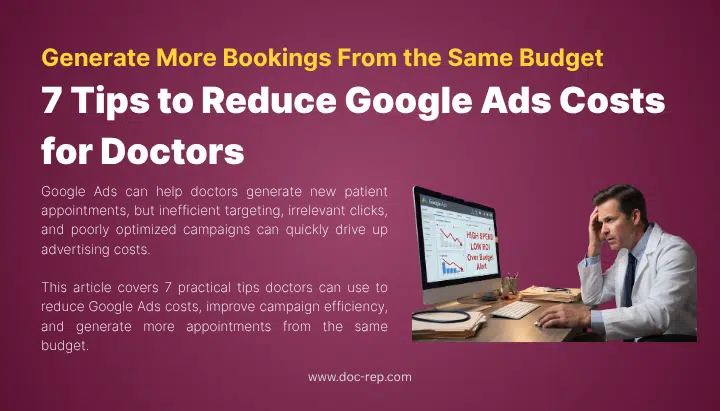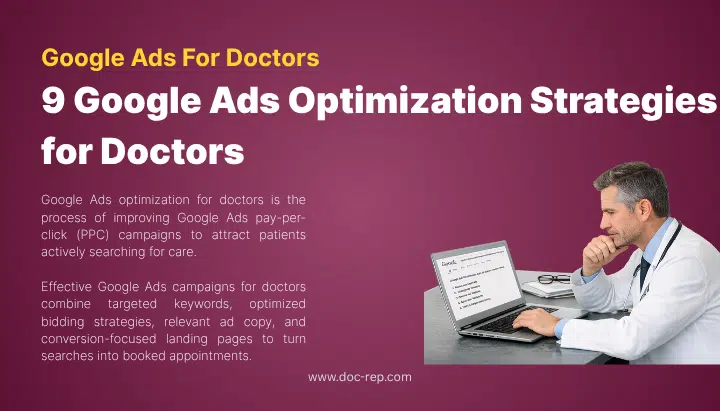
Google Ads for TMS clinics is a paid search advertising strategy that helps Transcranial Magnetic Stimulation providers attract treatment-ready patients actively searching for depression and OCD treatment options.
Google Ads delivers immediate visibility for TMS therapy, FDA-cleared depression treatment, Deep TMS, and SAINT protocol services while supporting measurable patient acquisition through conversion tracking and call attribution.
Successful Google Ads campaign for TMS therapy requires HIPAA-compliant analytics, compliance with healthcare advertising policies, high-intent keywords, localized targeting, and optimized landing pages that convert qualified searches into consultations and patient starts.
This guide covers Google Ads strategy, HIPAA compliance, keyword targeting, campaign optimization, conversion tracking, ROI measurement, and patient acquisition for TMS clinics.
Are Google Ads Allowed for TMS Treatment?
Yes, Google allows TMS ads under its Healthcare and Medicines policy. Pure TMS clinics that do not offer addiction treatment or online prescribing usually do not need LegitScript certification. Clinics that also provide Spravato, ketamine, or telepsychiatry with prescribing fall under stricter rules and likely need it.
If your landing pages mention substance abuse treatment, medication-assisted treatment, or online prescribing of psychiatric drugs, Google will require LegitScript. Stripping that language from the TMS landing page is one workaround when only the TMS program is being advertised.
What Gets TMS Ads Disapproved
Four issues account for most TMS ad disapprovals:
- Guaranteed-result claims (“Cure your depression,” “Eliminate anxiety in 6 weeks”) violate the unrealistic-claims rule. Use “FDA-cleared treatment for major depressive disorder” instead.
- Prescription drug names (Spravato, esketamine, ketamine) in ad copy or landing pages without certification trigger automatic flags.
- Personalized ads built on health-condition targeting are blocked. Google’s personalized ads policy stops remarketing audiences and interest-based targeting tied to mental health.
- Before-and-after testimonials implying specific clinical outcomes get flagged. Quality-of-life patient quotes usually pass; PHQ-9 score numbers do not.
HIPAA-Safe Tracking
Google will not sign a Business Associate Agreement. Standard Google Analytics, the basic conversion pixel, and standard remarketing tags create HIPAA exposure on pages that contain protected health information.
The fix is server-side tracking through server-side Google Tag Manager, Freshpaint, or Ours Privacy. These tools route conversion data through your server, strip PHI, and send only hashed, allowed identifiers to Google. The HHS Office for Civil Rights flagged standard tracking pixels on healthcare sites as a HIPAA risk in 2022 and reaffirmed that position through 2024 to 2026 enforcement actions.
What Does a TMS Google Ads Campaign Cost?
A single-location TMS clinic should plan for $3,000 to $8,000 per month to see meaningful results. Multi-location groups run $8,000 to $25,000.
Below $1,500 per month, you cannot generate enough clicks for statistically useful optimization data inside a 30-day window. Above that floor, every additional dollar should be justified by cost-per-patient-start math, not cost-per-click math.
Which Keywords Should TMS Clinics Bid On?
TMS clinics should bid on treatment-aware keywords with local intent and avoid broad mental health terms that attract low-intent traffic.
Result-Driving Keyword Examples
These have high commercial intent and convert into consults at meaningful rates:
- tms therapy near me
- Tms in [your city]
- tms treatment
- tms therapy for depression
- tms clinic near me
- tms for depression near me
- accelerated tms
- saint tms (only if you offer the Stanford protocol)
- deep tms near me
- tms for ocd (only if your device has the matching FDA clearance)
These share three traits: the searcher knows what TMS is, wants a provider, and is usually within driving distance. Bid on these with exact or phrase match, not broad.
Negative Keyword Examples
The biggest source of wasted TMS ad spend is a missing negative keyword list. Add these as exact and phrase negatives at the campaign level on day one:
- reddit (catches tms reddit, rtms reddit, tms cured my depression reddit)
- tms at home (DIY device shoppers, not patients)
- magnetic stimulation (without TMS qualifier, pulls research traffic)
- tms shock therapy (confuses TMS with ECT)
- tms cost (high-volume confused query)
- tms unit / magstim 200 (researchers and device buyers)
- transmagnetic stimulation (frequent misspelling, low intent)
- side effects / lawsuit (research-stage searchers)
Adding negatives upfront typically cuts wasted spend by 20 to 30% in month one.
Why “Depression” Alone Burns Budget
Bidding on broad terms like “depression treatment” or “is depression treatable” pulls clicks from people researching the condition, looking for therapy, or comparing medications. None are close to a TMS decision. Always pair depression terms with a TMS qualifier: “tms for depression,” “tms treatment for depression,” “magnetic therapy for depression.”
How Should TMS Clinics Structure Their Campaigns?
A single-location clinic needs three campaigns, each with its own daily budget:
- Core TMS terms (tms therapy, tms treatment, tms clinic plus near-me modifiers)
- Protocol-specific (accelerated TMS, SAINT, deep TMS, if you offer these)
- Branded (your clinic name and variations) – Optional
Separate budgets stop a sudden spike in one term from draining the rest.
Geographic Targeting
Traditional TMS requires 30 to 36 sessions over 6 to 9 weeks, 5 days a week. Patients will not drive more than 30 to 45 minutes. Use radius targeting at 20 to 30 miles around the clinic. Run two separate campaigns: a tight local radius for traditional protocols, and a wider state or multi-state geography for accelerated and SAINT terms.
Ad Group Structure
One ad group per intent theme. Mixing “tms cost” with “tms therapy near me” in the same ad group means one set of search queries gets the wrong ad copy.
Working structure:
- Local TMS therapy (near-me terms)
- TMS for depression (depression-specific TMS variants)
- Accelerated and SAINT
- TMS for OCD (only with matching FDA clearance)
Stick with Search campaigns. Performance Max blends Search, Display, YouTube, and Discover in ways that often push spend toward low-intent Display impressions. The lack of control is a problem for sensitive healthcare verticals with high CPCs.
What Makes a High-Converting TMS Landing Page?
A high-converting TMS landing page answers three patient questions in the first scroll: is this real medicine, will my insurance cover it, and what happens if I call. The homepage rarely does this well, which is why sending paid traffic to it is the single biggest conversion killer in TMS marketing. Required elements:
- Clear H1 naming the treatment and condition: “FDA-cleared TMS Therapy for Treatment-Resistant Depression in [City]”
- FDA clearance language. NeuroStar has been FDA-cleared for major depressive disorder since 2008, with adolescent MDD (15-21) added in 2024. BrainsWay received FDA clearance in September 2025 for an accelerated protocol that cuts initial treatment from 4 weeks to 6 days, and in November 2025 for adolescent MDD.
- Insurance logos. Medicare, Aetna, BCBS, Cigna, UnitedHealthcare, Optum. Patients searching “tms cost” want logos before they read anything else.
- Provider credentials. Board certification, years performing TMS, total sessions delivered.
- Reassurance content. What a session feels like, common side effects (scalp discomfort, mild headache), time commitment, no anesthesia, patients drive themselves home.
- Conversion paths. Phone number in the header, click-to-call on mobile, short form, online scheduler if available.
- Page speed under 3 seconds on mobile. Most TMS clicks happen on phones.
Build separate pages for each protocol (traditional, accelerated, SAINT) and each location. A three-location TMS group in the Pacific Northwest tested a single combined TMS page against three city-specific pages. City-specific pages converted at 11.4% on average; the combined page at 4.8% on the same ad traffic.
How Do You Track ROI on TMS Google Ads?
Track ROI by closing the loop from click to patient start, not stopping at form fills. Without offline conversion imports, you cannot tell which keywords produce paying patients, only which produce form submissions.
The metrics that matter:
- Cost per inquiry (form submission or tracked call)
- Cost per scheduled consult
- Consult show-up rate (typically 60-75%)
- Consult-to-start conversion (typically 30-50%, gated by insurance verification)
- Cost per patient start
- Return on ad spend
Most agencies report on the first metric. The numbers below it are where the actual money lives.
The HIPAA-Compliant Tracking Stack
- Call tracking through CallRail or CallTrackingMetrics with a signed BAA. Use dynamic number insertion so each ad source gets its own tracked number.
- Server-side Google Tag Manager: The client-side container fires on the page, but actual data flows through your server, which strips PHI before sending hashed conversion events to Google.
- Enhanced Conversions with hashed customer data: Google accepts SHA-256 hashed email and phone, which is one-way and does not expose PHI.
- Offline conversion import from your CRM: When a lead becomes a scheduled consult, started patient, or completed treatment, push that back to Google with the original GCLID. This trains Smart Bidding on the right outcomes.
Sample ROI
A solo TMS practice in a mid-sized market with $5,000 monthly spend:
- 520 clicks at $9.60 average CPC
- 47 inquiries (9% landing page conversion)
- 24 scheduled consults (51% of inquiries)
- 17 consults attended (71% show rate)
- 7 patients start (41% of attended consults)
- Cost per patient start: $714
- Average patient revenue: $11,000
- ROAS: 15.4x
The same spend with no landing page, no negatives, and traffic dumped to the homepage typically produces 2 to 3 starts instead of 7.
What Are the Most Common Mistakes TMS Clinics Make?
Most failed TMS campaigns fail for the same reasons:
- Sending paid traffic to the homepage. The homepage talks about your practice. The landing page should talk about the patient’s depression and what TMS will do about it.
- Bidding on “depression treatment” without a TMS qualifier. Pulls in therapy seekers and medication researchers. Cheap CPCs, terrible conversion.
- No negative keyword list. Ads show for “tms reddit,” “at home tms,” and dozens of other low-intent searches.
- No call tracking. Most TMS leads call before they fill out a form. Without call tracking, the reporting is fiction.
- Treating ad copy like a clinical brochure. Patients searching for TMS are anxious and often desperate after multiple failed medications. Reassurance language outperforms journal-abstract language.
- Running ads without insurance messaging. Cost is the second-biggest objection after side effects. No insurance signal, no click.
- Using standard Google Analytics on PHI-containing pages. OCR enforcement actions starting in 2022 made standard GA4 a HIPAA risk on healthcare sites.
Google Ads vs. SEO vs. Social Ads for TMS
Google Ads delivers patient inquiries fastest. SEO delivers the cheapest long-term cost per patient. Social ads work for awareness but rarely produce treatment-ready searchers. Most established TMS clinics run Google Ads and SEO in parallel, with social used selectively.
| Channel | Speed to First Patient | Long-Term Value | Effort |
| Google Ads | 2-4 weeks | High while running, zero when off | Medium ongoing |
| SEO | 6-12 months | Compounds, defensible | High upfront |
| Meta/TikTok Ads | 4-8 weeks | Awareness, retargeting | High creative load |
| Microsoft Ads | 2-4 weeks | Often overlooked, older demo | Low (mirror Google) |
| Local Service Ads | 2-6 weeks | Pay-per-lead model | Low ongoing |
Microsoft Ads (Bing) deserves more attention than it gets. Bing’s user base skews older and more affluent, which matches the demographic that pays cash for treatment-resistant depression care.
How Long Until Google Ads Produce Patients?
First inquiries usually arrive within 2 weeks of launch. Stable cost-per-acquisition numbers take 2 to 3 months. The first 30 days are mostly setup and data collection.
- Weeks 1-2: Learning phase. CPC is unstable, conversion data is thin, and healthcare review may delay ad approval. Avoid major changes.
- Weeks 3-4: First search term reports. Add negative keywords from actual triggering queries. Pause underperformers.
- Month 2: Cost per inquiry should drop 15 to 25% as negatives kick in. Set up offline conversion imports.
- Month 3: Cost per patient start becomes measurable. First real budget decision: scale, hold, or kill.
A campaign with zero patients that starts by month 3 has a structural problem: wrong keywords, a broken landing page, an untrained intake team, or an insurance verification bottleneck. More budget will not fix it.
Google Ads Launch Checklist for TMS Clinics
This 11 steps google ads launch checklist for TMS therapy clinics covers the steps to launch a compliant, well-built TMS campaign. Work through it in order. Skipping the early steps, especially tracking, causes the most expensive problems.
- Verify your Google Ads account, clinic licensing, and service area before launching campaigns.
- Set up HIPAA-safe conversion tracking through a server-side or healthcare-focused tool before spending a dollar.
- Build separate ad groups for branded, depression-treatment, treatment-resistant, and local searches.
- Add a strong negative keyword list to block jobs, equipment, and pure-research searches.
- Write two responsive search ads per ad group, with honest, policy-safe copy and no guarantees.
- Add call, sitelink, and callout extensions to every campaign.
- Build a focused landing page for each ad group, matching the ad’s message.
- Add a clear privacy policy and consent banner to your site.
- Start with Manual CPC or Maximize Clicks, then move to Maximize Conversions once data builds.
- Review search terms weekly for the first month and add negatives as needed.
- Track leads through to booked consultations and started patients, keeping patient data out of Google tools.
Final Words
Successful TMS patient acquisition through Google Ads requires balancing technical precision with clinical empathy. Avoid the common trap of treating search traffic like generic leads; instead, provide a HIPAA-compliant, reassuring experience that directly addresses patient anxiety and insurance concerns.
Success depends on structural discipline: use of negative keywords, dedicated landing pages for each protocol, and closing the loop by tracking offline patient starts rather than simple clicks. While the platform offers immediate visibility, remember that stability takes time. Commit to a 14-day learning phase, audit your data, and focus on cost-per-patient-start metrics.
If results remain elusive after three months, address the fundamental structural bottlenecks before increasing your budget.
Need help with Google Ads for your TMS clinic? Doc-Rep provides Google Ads management services for TMS clinics as part of its TMS Clinic Marketing solutions. From HIPAA-compliant tracking and landing page optimization to campaign management and ROI reporting, Doc-Rep helps clinics attract more qualified patients and maximize marketing performance.

Atiur Rahman
Medical & Healthcare SEO Expert focused on turning search visibility into booked patients and revenue. Specialties: technical SEO, schema and LLM visibility, AI SEO/GEO, and local search for clinics.