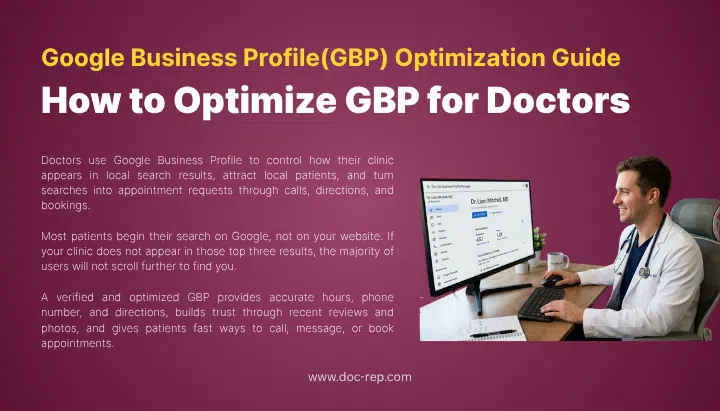
You’ve done everything right on the clinical side. Years of training, board certifications, a solid team, and a practice built actually to help people.
But when someone nearby searches for care, your name doesn’t show up. So those patients end up booking with whoever Google does show. This isn’t rare. It happens to great doctors all the time.
The reality is, being excellent at what you do doesn’t automatically make you visible online. Local search runs on a completely different system. And yes, that gap can quietly cost you new patients every single day.
The upside? This is fixable. Not with random marketing tricks, but with the right adjustments in the right places.
Let’s break down why your practice isn’t showing up in “near me” searches and what actually moves the needle.
How Local “Near Me” Search Works
Not all Google searches work the same way. A search like “what is TMS therapy for depression” is informational. But “TMS therapy near me accepting Blue Cross” is a local, high-intent search. One is about learning. The other is about finding care right now. You need both, but they follow different rules.

When it comes to local searches, Google is pretty clear about what matters. Rankings are driven by three core factors:
- Relevance – how closely your business matches what someone is searching for
- Distance – how close you are to the person searching
- Prominence – how strong your overall presence is online, including reviews, mentions, and authority signals
Why Medical Practice Doesn’t Show in “Near Me” Searches: 9 Reasons with Solution
A lot of doctors assume a beautiful website will solve this. It won’t. Design helps with trust, but it doesn’t guarantee visibility. In many cases, a simple, well-structured site with the right pages like services, location, about, insurance, and contact, combined with proper SEO, will outperform a high-end site that ignores search fundamentals.
If your practice isn’t showing up, it usually comes down to a few specific gaps. Nothing mysterious. Just signals that Google isn’t picking up clearly enough.
Let’s walk through the 9 most common issues and how to fix each one.
1. Google Business Profile Is Unverified
An unverified Google Business Profile rarely ranks in local searches.
Google needs proof that a real business exists at the stated address before it trusts the listing enough to show it to patients. Verification for medical practices usually requires a video call with Google, a postcard sent to your office, or a phone call to your published number. Video verification is now the default for most healthcare categories, following past fraud involving fake clinics.
When multiple providers share one location, each licensed practitioner can create a separate profile using their own name, but the shared address must show the same suite number and building details. Mismatched suite numbers trigger duplicate listing filters, and Google hides the weaker profile.
How To Fix: Go to your Google Business Profile dashboard and complete verification today. It’s the single highest-priority step you can take.
2. Inconsistent NAP Data
Inconsistent NAP (Name, Address, Phone) data confuses Google’s algorithm and drops your ranking. Your business name, address, and phone number must match exactly across every directory, insurance portal, and social profile. One wrong suite number in 50 places is enough to lower trust signals.
One wrong suite number in 50 places is enough to lower trust signals.
| Problem | NAP Mismatch Example | Fix |
| Name variation | “Dr. Sarah Chen, MD” vs “Sarah Chen Medical“ | Pick one legal name, use it everywhere |
| Abbreviation inconsistency | “123 Main St” vs “123 Main Street” | Match USPS-standardized format |
| Suite format drift | “Suite 200” vs “#200” vs “Ste 200” | Standardize to “Suite 200” |
| Phone format difference | (555) 123-4567 vs 555.123.4567 | Use one format across all listings |
| Outdated data still lives | Old address after relocation | Submit updates to each directory individually |
How To Fix: Audit your NAP on Google Business Profile, Healthgrades, Zocdoc, Vitals, WebMD, Yelp, Facebook, your state medical board listing, and your malpractice insurer’s directory. You can use BrightLocal NAP Checker to audit mismatches, then correct each listing manually.
3. Wrong Category Selection
Category selection decides which searches trigger your listing.
Your primary category carries the most weight, so choose the one that matches your core service.
A general practitioner should pick “Family practice physician” as primary, not “Medical clinic.” A cardiologist should select “Cardiologist” as primary and add “Medical clinic” and “Heart hospital” as secondary categories. Specialists who mislabel themselves as “Medical clinic” lose visibility for their specialty searches.
Adding too many unrelated secondary categories dilutes relevance. Stick to three or four that genuinely describe your services.
How To Fix: Review your primary category and correct it immediately. Then add three or four secondary categories that genuinely describe your services. Avoid stacking unrelated ones, as this dilutes relevance.
4. Too Few Recent Reviews
Review quantity, recency, and velocity all shape local rankings. A practice with 80 reviews from the past year beats one with 300 reviews from five years ago.
And the numbers back this up, 97% of consumers read online reviews before choosing a local business, and healthcare is no exception.
How To Fix: Set up a simple, automated post-visit review request. Aim for a steady drip of 5–10 new reviews per month rather than one large burst.
HIPAA-compliant review requests avoid any mention of specific conditions, treatments, or identifying details. Send a generic text or email after the visit saying, “Thanks for choosing our office. If you had a good experience, we’d appreciate a Google review.”
Never ask about medical outcomes. Confirming treatment details, even in a positive review, counts as a HIPAA breach.
When responding to reviews, never confirm that the person is a patient. A safe response reads: “Thank you for your feedback. We appreciate you taking the time to share.”
5. Overly Broad Service Area
An overly broad service area hurts rankings.
Setting a 50-mile radius when your real patients come from five miles away tells Google you serve nobody in particular. Stick to the zip codes where 80% of your patients actually live.
For multi-location practices, create a separate profile for each office with its own radius. Do not list all locations on one profile.
How To Fix: Pull your patient zip code data and limit your service area to the zones where your patients actually live. Precision signals relevance.
6. Dormant Profile Signals
Activity signals affect local ranking, even modestly.
Google rewards profiles that stay active with fresh content through Google Posts.
Post types that work for medical practices include seasonal health tips (flu shot reminders in October), new service announcements (now offering telehealth), staff introductions (meet our new nurse practitioner), and event notifications (free blood pressure screening Saturday).
Posting once a week moves the needle. Posting once and forgetting for six months does nothing.
How To Fix: Post at least one per week. It doesn’t need to be elaborate; a short health tip or a photo update is enough to keep your profile alive in Google’s eyes.
7. Website Lacks the Local Signals
Your website needs local schema markup, mobile responsiveness, and location pages.
These three elements connect your site to your Google Business Profile and strengthen both.
Multi-location practices need a unique page for each office with its own address, hours, staff, and embedded Google Map. Do not duplicate content across location pages. Each page should mention the neighborhood, nearby landmarks, and specific services offered there.
How To Fix: Add schema markup using MedicalClinic, Physician, or LocalBusiness types. This tells Google’s algorithm exactly what your practice does and where it operates, and most competitors skip this entirely.
8. Lack of Local Citation Network
Healthcare-specific directories carry the most weight.
Claim and complete your listings on Healthgrades, Zocdoc, Vitals, WebMD, Doximity, and RateMDs. Each one passes authority signals to Google.
General directories still help. Yelp, Yellow Pages, Better Business Bureau, and your local chamber of commerce all count. Tools like Whitespark, BrightLocal, and Moz Local find duplicate listings and clean up incorrect citations faster than manual work.
9. Limitation of Local Backlinks
Local backlinks tell Google your practice is part of the community.
Partner with local health organizations, gyms, senior centers, and community groups that list you on their resource pages.
Sponsor local events like 5K runs, school health fairs, or farmers’ markets. Organizers almost always link back to sponsors on their websites.
Write guest articles for regional health publications, local parenting blogs, or neighborhood newsletters. A single backlink from a well-known local news site often outweighs 50 directory citations.
What You MUST NOT Do to Rank Your Medical Practice Locally
Local SEO comes with real rules, and in healthcare, breaking them doesn’t just risk a ranking drop. It can trigger profile suspension, regulatory scrutiny, and HIPAA violations. These are not gray areas. Avoid them entirely.
- Keyword Stuffing Your Business Name: Adding terms like “Best Cardiologist Near Me” to your legal business name violates Google’s guidelines and leads to profile suspension.
- Creating Fake or Virtual Office Locations: Listing a practice at a UPS Store, virtual address, or any location where no actual care is delivered is a direct violation of Google’s policies — and potentially of state medical board regulations.
- Buying or Fabricating Patient Reviews: Paying for fake reviews, incentivizing patients with discounts or gifts, or using review farms is prohibited by Google, the FTC, and most state medical boards.
- Confirming Patient Identity in Review Responses: Acknowledging that a reviewer is or was a patient, even in a positive response, constitutes a HIPAA violation. Never reference treatment details, appointment history, or any identifying information in a public review response. Keep all responses generic.
- Letting Duplicate Listings Go Unchecked: Duplicate Google Business Profile listings split your authority and confuse patients. If you’ve moved offices, rebranded, or had a listing created without your knowledge, those old profiles need to be removed or merged, not left to compete against you silently.
Quick Fix Checklist (Start Here)
Run through this checklist before touching anything else. These are the highest-impact fixes that move rankings the fastest, usually within 30 to 60 days.
- Claim and verify your Google Business Profile. Complete video or postcard verification. Unverified profiles rarely show in Map Pack results.
- Fix NAP consistency. Audit your name, address, and phone number across Google, Healthgrades, Zocdoc, Vitals, WebMD, Yelp, and your insurance directories. Match every detail, including suite numbers.
- Get 10 to 20 new reviews. Send HIPAA-compliant review requests to recent patients. Focus on recency and steady flow, not one big batch.
- Optimize categories. Set a specific primary category (like “Cardiologist” not “Medical clinic”) and add three or four relevant secondary categories.
- Add photos. Upload at least 20 photos: exterior, interior, exam rooms, staff headshots, and team shots. Refresh every three months.
- Fill every profile field. Hours, services, attributes, accepted insurance, languages spoken, and appointment booking links. Empty fields weaken relevance signals.
- Post weekly on Google Business Profile. Share health tips, seasonal reminders, new services, or staff updates. Activity signals matter.
- Add location schema to your website. Use MedicalClinic, Physician, or LocalBusiness markup so Google reads your site correctly.
- Respond to every review within 48 hours. Keep responses HIPAA-safe. Never confirm treatment details or patient status.
- Fix mobile speed. Test your site on Google PageSpeed Insights. Aim for under 2.5 seconds load time and working click-to-call buttons.
Finish this list first. Most practices see measurable movement in profile views, calls, and direction requests before deeper work like backlinks or content pays off.
Final Words
Local search visibility comes down to trust signals. Google wants to show patients the practice that best matches their need, sits closest to them, and looks most credible to the wider web.
Start with the basics this week: claim and verify your Google Business Profile, fix your NAP data across the top directories, and ask your next twenty happy patients for a review. Treat local SEO as an ongoing habit, not a one-time project, and patients will find you first.
FAQs
How long does it take for a medical practice to rank in local searches?
Complicated to say the exact time. New practices usually see Map Pack movement in 3 to 6 months. Established practices with fixable issues often see results in 30 to 60 days.
How do I track whether my “near me” fixes are working?
Track progress with three tools: Google Business Profile Insights, grid-based rank checkers, and patient acquisition surveys.
What is the Google Map Pack, and why does it matter?
The Map Pack is the block of three local business listings that appears at the top of Google search results, above organic links, for local searches. It includes a map, star ratings, hours, and links to call or get directions. Studies show that the Map Pack captures the majority of clicks for “near me” searches. If your practice isn’t in those top three spots, most patients searching nearby won’t see you at all.
Do I need a separate Google Business Profile for each doctor at my practice?
It depends. Each licensed practitioner can create their own individual profile using their name — especially useful for specialists who want to rank for their specific specialty. However, the shared address must use identical suite and building details on every profile to avoid triggering duplicate filters. If you have five providers in one office, five individual profiles plus one practice profile can all coexist, but consistency across all of them is non-negotiable.
Should I hire a local SEO specialist for my practice?
Yes, regardless of your practice size. Local SEO is not a one-time task. Google updates its algorithm often, competitors change their strategies, reviews need responses, citations need monitoring, and content needs regular updates. Your time is better spent on patients and practice growth.

Atiur Rahman
Medical & Healthcare SEO Expert focused on turning search visibility into booked patients and revenue. Specialties: technical SEO, schema and LLM visibility, AI SEO/GEO, and local search for clinics.