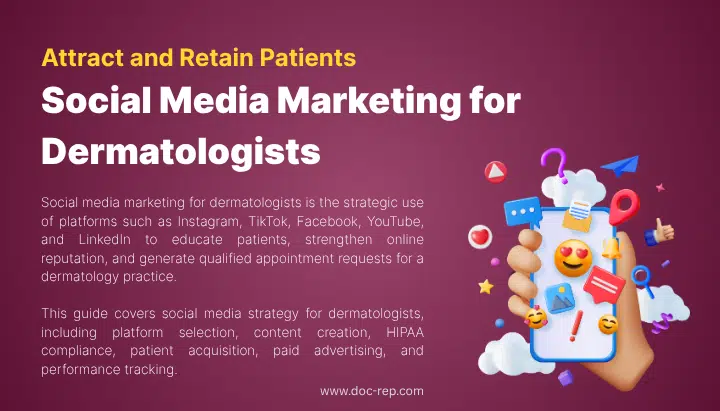
Effective social media marketing combines educational skin care content, treatment explanations, before-and-after results shared with proper consent, patient engagement, and consistent branding to build trust while complying with HIPAA and medical advertising regulations.
Modern dermatologists use short-form video, Reels, patient education, cosmetic and medical dermatology content, and local community outreach to increase visibility, improve patient acquisition, and support long-term practice growth.
Successful dermatology social media marketing campaigns measure engagement, conversions, appointment bookings, and return on investment to continuously improve marketing performance.
This guide covers social media strategy for dermatologists, including platform selection, content creation, HIPAA compliance, patient acquisition, paid advertising, and performance tracking.
Why Do Dermatologists Need Social Media Marketing in 2026?
Dermatologists need social media marketing in 2026 because today’s patients research providers online before booking an appointment. Most people search for skin concerns, watch educational videos, read reviews, and visit a dermatologist’s social media profiles to evaluate expertise and credibility. Social media bridges the gap between online research and patient trust, complementing search engines and referrals rather than replacing them.
The opportunity is significant. According to the Pew Research Center’s 2025 survey of 5,022 U.S. adults, YouTube reaches 84% of adults, Facebook 71%, Instagram 50%, and TikTok 37%. While these figures reflect audience reach rather than appointment bookings, they show where prospective patients actively consume health and lifestyle content.
Social media also influences treatment decisions. The American Society for Dermatologic Surgery’s 2025 Consumer Survey found that 70% of respondents were considering a cosmetic procedure, nearly half said a provider’s social media presence influenced their decision to book, and 94% relied on online ratings and reviews when choosing a provider. Reviews help patients identify qualified dermatologists, while social media builds familiarity and confidence before the first consultation.
For local practices, social media is a powerful patient acquisition tool. Location-targeted advertising, geotagged posts, and educational videos featuring dermatologists help practices reach nearby audiences and establish a recognizable presence in their community.
Although social media is not a direct Google ranking factor, it supports search visibility by helping practice profiles appear in branded searches, increasing exposure through YouTube videos, and encouraging branded searches after users discover content on platforms like Instagram or TikTok.
Which Social Platforms Work Best for Dermatologists?
Instagram works for visual proof. TikTok and Reels work for reach. Facebook works for older local patients. YouTube works for procedure research. LinkedIn works for referrals. Most practices should run two well, not five badly.
Here is how the main options compare for a dermatology practice.
| Platform | U.S. adult use (Pew, 2025) | Best use for a derm practice | Main constraint |
|---|---|---|---|
| YouTube | 84% | Long procedure explainers, consult prep videos | Production time per video is high |
| 71% | Local awareness, patients 50 and older, event and hiring posts | Organic reach for pages is low without paid support | |
| 50% | Treatment showcases, provider intros, Stories for daily contact | Heavy competition in cosmetic content | |
| TikTok | 37% | Short skin education, myth correction, reach beyond followers | Trend formats can clash with clinical tone |
| Not measured in this Pew report | Referral relationships, staff recruiting, professional credibility | Almost no direct patient booking |
Pew’s 2025 data also shows a sharp age split. Eight in ten adults ages 18 to 29 use Instagram. Only 19% of adults 65 and older do. Facebook peaks among adults 30 to 49, where 80% use it. If your patients skew older, you need Facebook.
Instagram: Visual Proof and Treatment Showcases
Instagram fits skin care because it rewards clear images and short video. Half of U.S. adults use it. Women use it more than men, at 55% versus 44%. That matches who buys most cosmetic services.
Use the grid for posts that last. That means treatment explainers, provider intros, and condition basics. Use Reels for reach. Use Stories for the small daily stuff that keeps current followers warm.
The Instagram trap is sameness. Filtered result photos, quote cards, and stock skincare photos blur every practice into one. Specific content wins. A 40-second clip of your PA explaining how a punch biopsy feels will beat another pretty graphic about hydration.
TikTok and Short-Form Video: Reach and Skin Education
TikTok and short video give you reach beyond your follower count. The app spreads posts by topic interest, not by who follows you. That makes it the fastest way to be found by people with a skin question and no doctor.
Pew found 37% of U.S. adults use TikTok. Use runs much higher among adults under 30. That helps if you want acne, hair loss, or entry-level cosmetic patients. It helps less for Mohs surgery or long-term disease care.
Short video works best for narrow questions you can answer. Why tretinoin causes peeling in week two. What a mole check involves. Whether sunscreen expires. One question, one answer, under 60 seconds.
False skin advice spreads fast on these apps. Correcting it is good content. Keep the tone calm and say what the evidence shows. Mocking a trend reads badly and rarely books anyone.
Facebook: Local Community and Older Patient Segments
Facebook reaches 71% of U.S. adults. It is still the best app for local patients over 50. It also has the highest daily use Pew measured, with 52% of U.S. adults on it each day.
Use it for practice news, new provider notices, insurance and hours updates, local events, and hiring. Facebook Groups in your city often carry threads where people ask for a skin doctor. Your name can come up there without you posting at all.
Free page reach is weak. Treat Facebook as a paid channel with a free base, and budget for that.
YouTube: Long-Form Procedure Explainers
YouTube reaches 84% of U.S. adults. It serves patients who are past browsing and into research. Someone who searches “what happens during Mohs surgery” is much closer to booking than someone scrolling a feed.
Good formats include full procedure walk-throughs, recovery timelines, first-visit explainers, and answers to the questions your front desk repeats all day. Five to twelve minutes fits most of these topics.
YouTube content also lasts. A well-titled video keeps pulling views for years. A Reel does not. So YouTube takes the most work and often gives the most back per video.
LinkedIn: Referral Networks and Professional Authority
LinkedIn helps with referrals and hiring, not with direct patient booking. Its audience is other clinicians, office managers, industry, and job seekers.
Post practice news, research work, conference talks, and open roles. Providers should keep their own profiles current. Referring doctors look at people, not practice pages.
Do not judge LinkedIn on consult volume. Judge it on referral ties and the quality of job applicants.
What Should Dermatologists Actually Post on Social Media?
Post a mix of teaching, service explainers, provider content, and results that follow the rules. A ratio that works is about half teaching, a quarter provider and practice content, and a quarter service or offer content.
The sections below cover each type and its constraints.
Educational Content That Builds Clinical Trust
Teaching content is the base layer. It answers the questions people already type into search. It also shows a licensed clinician stands behind the account.
Good topics include how a condition is found, what a treatment does to the skin, what healing looks like, and what a symptom does not mean. Name how it works. “Retinoids speed up how fast skin cells turn over” teaches more than “retinoids renew your skin.”
Say what you do not know. When the evidence is mixed, saying so builds trust rather than losing it.
Treatment and Service Spotlights
A service post covers one service at a time. What it treats. Who it suits. How much time it takes. What it does not do. Vague plugs for “our aesthetic menu” get nothing.
Cover the full details. Number of sessions. Downtime in days. What happens if results fall short. Whether insurance applies. Patients weigh cost and pain heavily. In the 2025 ASDS survey, 24% named cost as a reason they held off. Pain was named by 14%. Side effects or safety were named by 16%.
Answering the doubt head-on does more than repeating the benefit.
Before-and-After Results: What Is Allowed and What Is Not
You can post before-and-after photos. You need three things first. A signed written consent from the patient. Images shown as they are, with no edits. And posts that follow your state ad rules and the platform’s ad policy. A verbal yes from the patients is not enough.
Three separate rule sets apply at once.
HIPAA comes first. A photo that shows who a patient is, and hints that you treated them, counts as sharing protected health information. To use it in marketing you need a signed HIPAA form, called an authorization, that names that use. The U.S. Department of Health and Human Services Office for Civil Rights has enforced this more than once. In February 2016 it settled with a physical therapy provider that posted patient stories with names and photos and no signed form. In October 2019 a dental practice paid $10,000 to settle social media disclosures of patient information.
State law comes second. California Business and Professions Code section 651 bars images that do not show the true result. It also bars images changed in any way from the real subject. Any photo of a model must be labeled as a model, in a spot people can read. Before-and-after photos of a real patient must say which procedures were done. Other states have their own rules. Check yours.
App policy comes third. Meta limits cosmetic and health ad creative. That includes side-by-side comparisons for anti-aging treatments. Meta also bars ads that make people feel bad about themselves in order to sell a health or beauty product. These rules change often. Check the current standards before you launch, not after a rejection.
One more point, from the ethics side. A 2022 letter in the Journal of the American Academy of Dermatology looked at a common offer. Some practices cut the price of a cosmetic procedure in exchange for the right to post the patient’s photos. The authors said this sets up a trade, not a free choice. Patients may feel pushed to agree, since the doctor holds power in the room. And the post gives the patient no medical benefit. If you run that offer, tell the patient why you want the photos, what the risks are, and that they can pull consent at any time.
Provider Introductions and Behind-the-Scenes Content
Provider content books visits because patients choose people. A short intro covering training, clinical interests, and manner takes the fear out of a first visit.
Behind-the-scenes content works when it is real. Show room turnover. Show how a biopsy sample is handled. Show what the front desk needs on a first call. Skip staged office fun. It reads as filler and weakens your clinical tone.
Keep patients and their details out of frame. A hallway shot with a visible schedule board or chart screen counts as a disclosure.
Patient Stories, Reviews, and User-Generated Content
Patient stories and shared reviews need the same signed written consent as photos. They must also follow FTC rules on reviews.
The FTC’s Rule on the Use of Consumer Reviews and Testimonials took effect on October 21, 2024. It bars buying good or bad reviews. It bars fake reviews. It bars insider reviews with no disclosure. It bars review sites the company controls. And it bars hiding bad reviews. Breaking it on purpose brings money penalties. The cap is adjusted each year. Law firm coverage in late 2025 put it at up to $53,088 per violation.
Practical rules that follow from this:
- Do not offer a discount, a product, or a prize drawing for a good review. Rewards tied to the rating are the core problem.
- Say so when a reviewer works for you, is family, or is tied to the practice in any way.
- Do not delete or hide bad reviews you control.
- Do not reuse a review for a service that patient never had.
If a patient posts about you on their own, that is their speech. The moment you share it to your account, it becomes your ad. The rules then apply to you.
Myth-Busting and Trend Response Posts
Myth correction works when it is specific and calm. Name the claim. Say what the evidence shows. Explain how it works. Then stop.
Pick myths that carry real risk. Skipping sunscreen. Home chemical peels. Home mole removal. Unproven acne cures. These cause real harm. Fixing a harmless trend wastes a post.
Move fast when a claim spreads in your area. A fix posted three weeks late reaches almost no one.
Seasonal and Awareness-Month Campaigns
Seasonal content should match when demand moves. Skin Cancer Awareness Month falls in May. Summer brings sun protection. Winter brings eczema and dry skin. Fall is when patients book procedures with downtime before the holidays.
Plan these at least six weeks ahead. Awareness months get crowded. A post on day one gets more attention than a post on day twenty.
Tie each campaign to one action. Book a skin check. Request a consult. Download a form. A campaign with no action attached gets reach and nothing else.
How Do You Build a Dermatology Social Media Strategy?
Start with one main goal. Then define the patient you want. Choose a medical or cosmetic focus. Set a posting pace you can keep. Lock in a look and a voice. Skip any of these and the account drifts.
Defining Your Goals: Awareness, Bookings, or Retention?
Pick one main goal per quarter. The three common goals need different content and different scoring.
Awareness fits new practices, new offices, and new services. The content is broad. Reach is the score. Bookings take a long time to show up.
Bookings fit set practices with open consult slots. The content names services. The asks are direct. The score is consults traced to social.
Retention fits practices with plenty of volume but weak return rates. The content covers aftercare, how often to come back, and product help. The score is repeat visits and no-show rate.
Chasing all three at once gives you a feed with no pattern.
Identifying Your Ideal Patient and Service Mix
Define the patient by service, payer, and place. Do not use broad age and gender. “Women 25 to 54” is not a target. “Cash-pay patients within 20 minutes who want injectables and watch the price” is.
Start from your own data. Pull your last 200 new patients. Which services did they come for. Which paid best. Which had open slots you could not fill. Aim your content at that gap.
The 2025 ASDS survey found interest is broad but action is slow. Cost was the top reason people waited. If your patients pause on price, content about value and payment plans will move more of them than content that shows results.
Choosing Medical vs. Cosmetic Positioning
Medical and cosmetic content pull in opposite directions. Medical content signals that you are serious. Cosmetic content signals a look. A blended feed usually weakens both.
Three workable approaches:
- One account, clear lanes. One feed, but medical and cosmetic posts use their own look and tags.
- Two accounts. Cleaner split and better targeting, but twice the work. Only do this if you have the staff.
- Split by provider. The medical doctor posts clinical content. The cosmetic provider posts beauty content. Both link to the practice.
Whatever you pick, do not let cosmetic plugs outweigh medical content. Patients use that same account to judge your skin cancer care.
Building a Content Calendar and Posting Cadence
Set a pace you can hold for twelve months. Then build the calendar back from it. Three posts a week for a year beats daily posts for six weeks and then silence.
A practical starting cadence for a single-location practice:
- Instagram: three feed or Reel posts a week, plus Stories on clinic days
- Facebook: two posts a week, mostly repurposed
- YouTube: two videos a month
- TikTok: two to three short videos a week, often repurposed Reels
- LinkedIn: two posts a month
Batch the work. One two-hour filming session can yield six to eight short videos. Trying to make content daily between patients fails within a month.
Establishing a Consistent Brand Voice and Visual Style
Write down the rules for how posts look and sound. Then any staff member can make content that fits. This is the cheapest quality check you have.
Cover at least these items. Colors. Fonts. A caption template. How you name providers and list their credentials. Reading level. Whether you use humor. And what you never say. Add a short list of claims a provider must review before you post.
Sticking to it matters more than polish. A plain style you post on schedule beats slick work you post at random.
How Do You Stay Compliant as a Dermatologist on Social Media?
Treat every post as a possible disclosure. Treat every claim as an ad. Three rule sets apply. HIPAA covers patient information. FTC rules cover claims and reviews. State medical board law covers ads.
HIPAA Rules for Patient Photos, Comments, and DMs
HIPAA applies any time a post shows who a patient is and hints that you treated them. That covers photos, names, dates, tattoos or scars, and any detail specific enough to point to one person.
Comments and direct messages are the most common failure point. A patient may post their own health details in public. If your reply confirms they are your patient, you have made a disclosure. Their post does not let you off the hook.
Two federal enforcement actions make the point.
In June 2023, OCR reached a deal with a New Jersey health care provider. The provider had shared patient information in replies to bad online reviews. Reports on the case put the payment at $30,000.
In October 2019, OCR settled with a dental practice for $10,000. The case involved patient health information shared on social media.
The safe reply to any public comment about care is short and plain. Thank the person. Say you cannot discuss care in public. Give a phone number or portal link. Never confirm, deny, or add detail.
Consent Documentation for Before-and-After Images
Consent for marketing images must be a written HIPAA form. It must name marketing use. Keep it in the patient record.
At minimum the form should state:
- Exactly which images it covers
- Where they may appear, with each app named, plus paid ads
- How long the consent lasts
- That the patient can cancel it, and what cancelling can and cannot undo
- Signature and date
Say the limit out loud. Once an image is public, other people can save it and share it. You can delete your post. You cannot pull back every copy. Patients who hear this up front are less likely to feel misled later.
Keep a photo log. Note which patient signed off on which images, on what date, and for which apps. When staff leave, that log is the only thing between you and a post no one approved.
FTC and Advertising Rules for Cosmetic Claims
The FTC treats cosmetic marketing claims as ads. They must be true, and you must be able to back them up before you post.
Some claims need proof in hand. Exact result percentages. How long results last. Any comparison to other treatments. And any claim that a procedure treats a medical condition. Adding the word “may” does not remove the need for proof.
The Rule on the Use of Consumer Reviews and Testimonials adds duties around reviews, as covered above. The Endorsement Guides, updated in June 2023, require clear disclosure of any material connection. If you pay, gift, or discount in exchange for a post, the poster must say so plainly. Making sure they do is your job.
Handling Medical Advice Requests in Comments
Do not give one-on-one medical advice in comments or messages. That person is not your patient. You cannot examine them. And the exchange is either public or never logged.
Use a set reply. Note the question. Give general information if it fits. Then point them to booking. Write the exact wording once, put it in your style guide, and have staff use it word for word.
Flag urgent wording for a provider. A comment about a fast-changing spot, or a spreading rash with fever, should go to a clinician the same day. Do not answer it with a template.
Internal Approval Workflows and Staff Training
Write down the workflow and name the roles before you post more. Most rule breaks come from speed, not bad intent.
A workable structure:
- One person writes and schedules posts
- A clinician reviews any post with clinical claims, patient images, or results
- One named person checks every patient image against the photo log and the signed form
- One person owns comments and messages, working from approved templates
Train once a year and keep records of it. Cover what counts as protected health information. Cover why consent for one app does not carry to another. Cover why replying to reviews is high risk. And cover who to escalate to. Include everyone with account access, agency staff included..
Which Metrics Prove Your Dermatology Social Media Marketing Is Working?
Four numbers prove social media works. Consults requested. Consults traced to social. Procedures booked. And cost per new patient. Followers, likes, and views are inputs, not results.
Vanity Metrics vs. Patient-Acquisition Metrics
Split these into groups and report each on its own.
| Metric type | Examples | What it tells you | What it does not tell you |
|---|---|---|---|
| Reach and engagement | Followers, impressions, likes, shares, watch time | Whether content is being seen and held attention | Whether anyone became a patient |
| Intent | Profile visits, link clicks, saves, direct messages | Whether viewers moved toward action | Whether the action completed |
| Acquisition | Consult requests, booked appointments, show rate, revenue by service | Whether the channel produced patients | Why a specific post worked |
Report all three. Reach with no interest means the content is fun but not convincing. Interest with no new patients means the booking path is broken.
Tracking Consults, Bookings, and Cost Per Patient
Track four numbers each month. Consult requests traced to social. Consults that showed up. Procedures booked from those consults. And total social spend, staff time included.
Cost per new patient is total cost divided by new patients. Include labor. A practice that pays a staff member for ten hours a week on social is spending real money. Leave that out and the channel looks cheaper than it is.
Compare that number to the average value of the service you are pushing. Do not compare it to a generic benchmark. A cost per patient that works for a laser package may not work for one acne visit.
Tracking will never be exact. A patient may see six posts, run one search, and tell you they found you on Google. Accept a rough read and watch the trend over quarters.
Reporting Cadence and When to Change Direction
Report each month. Decide each quarter. Monthly reports catch day-to-day problems. A quarter is the right window for strategy changes. Booking cycles in skin care run long, and cosmetic patients often research for months.
Change course when new patient numbers stay flat for two quarters in a row while reach and interest rise. That pattern means the content works and the booking path does not. Fix the path first. Changing content here throws away the audience you built.
What Mistakes Do Dermatology Practices Make on Social Media?
Four mistakes come up again and again. Posting at random. Selling too much. Chasing trends that hurt your clinical standing. And ignoring comments and messages. Each has a clear fix.
Posting Inconsistently or Abandoning Accounts
Practices often launch with lots of posts, then stop. An account whose last post is from 2024 makes people wonder if you are still open.
The cause is almost always time, not will. Set your pace at what you can hold in your busiest month, not your slowest. If that is one post a week, post once a week. If you cannot keep an account going at all, take it down rather than leave it stale.
Over-Promoting Instead of Educating
A feed that reads as one long sales pitch loses the people who would have booked later. Nobody follows a practice to see offers.
This is easy to spot. Count your last 20 posts. If more than eight push a service, a price, or an offer, you are selling too much. Shift back toward teaching. Teaching also earns more reach on every app listed here.
Copying Trends That Undercut Clinical Credibility
Trend formats built for fun can clash with your standing as a clinician. Dance clips, over-the-top reaction videos, and jokes about patient conditions all carry that risk.
Referring doctors and future medical patients see the same feed as your cosmetic audience. Posts that read as unserious cost you referrals you never hear about. Use trending sounds and formats when they carry real information. Skip them when the trend is all there is.
Ignoring Comments and Direct Messages
Comments and messages you never answer are lost patients. Someone who asks “do you take Aetna” and hears nothing books somewhere else that week.
Name one person who owns replies and set a response window. Check messages daily on every active app. If the volume beats what your staff can handle, drop an app rather than slow your replies.
Final Words
Social media works for skin practices when you run it as a system, not as a posting habit. The content choices are the easy part. What decides whether it brings patients is the booking path, the consent log, the reply process, and the monthly number that shows how many consults came from the channel.
Start narrow. Pick one app, one main goal, and a pace you can hold through your busiest month. Write down the rules process before you post more. Undoing a photo you had no right to post costs far more than stopping it. Then measure new patients, not applause.

Medical & Healthcare SEO Expert focused on turning search visibility into booked patients and revenue. Specialties: technical SEO, schema and LLM visibility, AI SEO/GEO, and local search for clinics.
More from AtiurBook a free 30-minute strategy call and we’ll show you where the biggest opportunities are.