For most medical practices, we run Google Ads first to start patient flow, build the SEO foundation in parallel, and once the practice has a steady patient base, we turn off paid ads and let SEO compound.
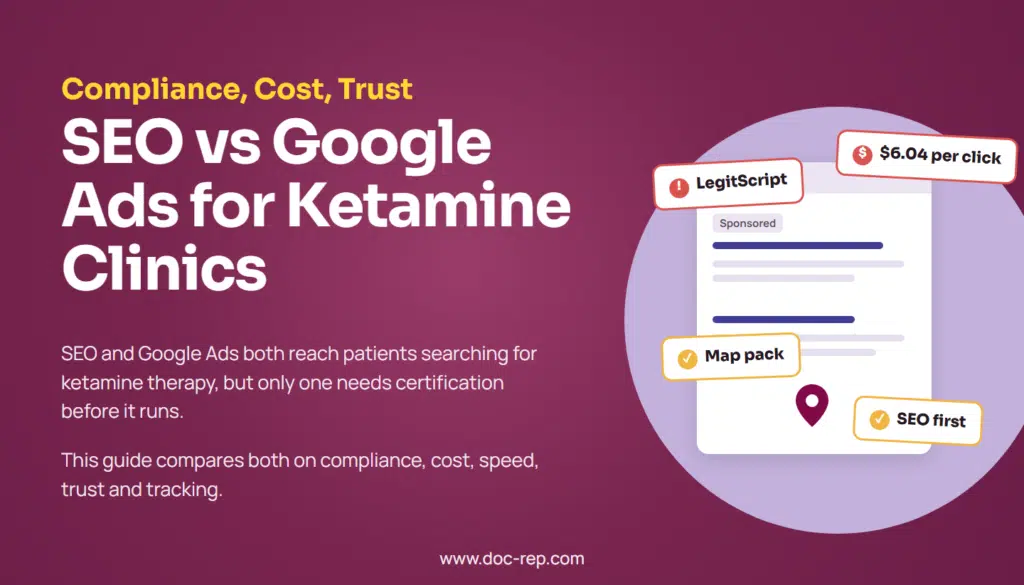
Ketamine clinics are different. Google Ads for ketamine is compliance heavy and expensive: you usually need LegitScript certification and Google healthcare verification before ads run reliably, clicks cost more than the typical health category, and disapprovals or suspension can cut off leads without warning. The quick, affordable patient flow that justifies ads first rarely shows up.
So for ketamine clinics we flip the order. SEO and the Google Business Profile become the foundation from day one, and Ads become an optional add-on once the clinic is certified and the numbers justify it.
This guide compares both channels on compliance, cost, speed, trust, reach, and tracking, using real numbers from a ketamine campaign we ran.
What Is the Difference Between SEO and Google Ads for Ketamine Clinics?
SEO earns free listings in Google’s organic results and map pack, while Google Ads buys paid placements at the top of the page. Both show up when someone searches “ketamine therapy near me,” but they work in very different ways.
| Factor | Google Ads | SEO |
|---|---|---|
| Placement | Paid spots at the top of the page with a “Sponsored” label | Free listings in organic results and the map pack |
| How you pay | Every time someone clicks your ad | For the work, not the clicks |
| Approval | Only after Google approves your account to advertise a controlled substance | No approval needed to publish |
| Location | Radius around the clinic | City and neighborhood pages, Google Business Profile |
| Keywords | Limited to terms that pass healthcare policy review | Long-tail terms like “how many ketamine sessions for PTSD” |
| How it works | Bid on keywords and pay for visibility | Improve your website, content, and Google Business Profile so Google ranks you on its own |
| When you stop | The ad disappears and so do the leads | Rankings stay in place for months, as long as competitors don’t outpace you |
| What you get | Rented visibility under strict rules | An asset your clinic owns |
Why Is Google Ads So Compliance Heavy for Ketamine Clinics?
Ketamine is a Schedule III controlled substance, so ads for it fall under Google’s healthcare and medicines policy, one of the strictest ad categories Google has. SEO content has rules too, but nothing that blocks you from publishing.
- Certification before you can run: Clinics running ketamine ads generally need LegitScript healthcare certification and Google Healthcare Advertiser Verification before ads will run reliably. If your clinic also offers addiction treatment, LegitScript certification is required for those ads on Google, Meta, and Microsoft Ads.
- Weeks of waiting: LegitScript certification typically takes 4 to 8 weeks from application to approval, depending on how complete your application is. You pay the application and annual fees during that time with zero leads to show for it.
- Disapprovals and appeals: Even certified clinics see ads and keywords disapproved, which means reviews, appeals, and paused campaigns.
- Suspension risk: Repeated policy violations can lead to account suspension, which is much harder to fix than a single disapproval. A suspended account can cut off your paid leads overnight.
- Ongoing upkeep: Certification has to be renewed, and ad copy and landing pages have to stay within policy every time you change them.
SEO Content Compliance for Ketamine Clinics
SEO content must still avoid claims you can’t back up. The FTC’s Health Products Compliance Guidance, issued in December 2022, requires health claims to rest on competent and reliable scientific evidence, which generally means randomized, controlled human clinical trials. A line like “ketamine cures depression in one session” breaks that standard.
Be accurate about FDA status. IV ketamine for depression is used off-label. The FDA-approved form for treatment-resistant depression is esketamine nasal spray (Spravato), approved in 2019.
For HIPAA-safe content, get written patient permission before publishing any testimonial or case story. Keep patient details out of blog examples, form URLs, and tracking tools.
The difference is control. With SEO, compliance is about writing accurately, and you decide when a page goes live. With Google Ads, a third party decides whether you can advertise at all.
How Do Costs Compare Between SEO and Google Ads for Ketamine Clinics?
Google Ads costs grow with every click and never stop, while SEO costs stay flat and the cost per lead drops as rankings improve.
What Does a Ketamine Click Cost on Google Ads?
We ran a Google Ads campaign for ketamine depression treatment with an average CPC of $6.04, well above the $4.76 average for physicians. Clinics in large metro areas with more competing bidders usually pay even more.
| Metric | Result |
|---|---|
| Impressions | 14,000 |
| Average CPC | $6.04 |
| Total cost | $2,178 |
| Conversions | 9 |
| Clicks | 361 |
| Cost per conversion | $242 |
| Conversion rate | 2.5% |
Clicks, cost per conversion, and conversion rate are calculated from the first four numbers. Note that a conversion is a lead, not a patient. Many leads never book, so the true cost per started treatment is several times higher.
On top of click costs, Ads carry certification fees, landing page work, and campaign management time.
Our campaign ran on a budget of $25.40 per day. Once that budget was spent, ads stopped showing for the day. SEO has no such cap. A single well-ranked FAQ page can bring in hundreds of visitors a month at no extra cost.
What Does SEO Cost for a Ketamine Clinic?
SEO costs come from content creation, technical fixes, and ongoing optimization. Content includes treatment pages, condition pages, FAQ pages and blog posts. Technical work covers site speed, mobile layout, and schema markup. Ongoing work includes Google Business Profile updates, review management, and local citations.
Doc-Rep provides Ketamine SEO services for just $499 per month, covering the core SEO work needed to improve online visibility and attract more qualified patients.
Cost Comparison Over 3 and 6 Months
The table uses an example budget of $1,500 per month for Google Ads and $499 per month for SEO. Actual results vary by location, competition, and certification timing.
| Timeframe | Google Ads ($1,500/month) | SEO ($499/month) |
|---|---|---|
| Total spend, 3 months | $4,500, plus certification fees | $1,497 |
| Expected results, 3 months | Leads may be delayed by certification, ad review, appeals, or disapprovals | Initial rankings and organic traffic start improving |
| Total spend, 6 months | $9,000, plus certification fees | $2,994 |
| Expected results, 6 months | Leads continue only while ads stay approved and funded | Stronger rankings, traffic, and lead flow as SEO gains traction |
| What happens if you stop | Leads stop the same day | Rankings and traffic keep working |
Over six months, Ads cost about three times as much as SEO, and none of that spend leaves an asset behind.
SEO does take longer to mature. In its video on hiring an SEO, Google said most SEO work needs four months to a year before a business sees the benefit. But every month of SEO compounds: pages keep ranking, reviews keep building, and traffic keeps growing. Every month of Ads starts from zero.
Which Channel Builds More Patient Trust?
Organic listings and strong reviews build more trust than ads, because patients know the “Sponsored” label means someone paid for the spot.
Ketamine therapy is a high-cost, high-consideration treatment. Patients often research for weeks. Many are dealing with depression, PTSD, or anxiety that other treatments did not fix. They read reviews, compare clinics, and look for signs of medical credibility before they call.
That research happens in organic results. Pages that show your medical director’s credentials, your screening process, and your safety protocols answer the questions patients ask before booking. Your Google Business Profile matters just as much: a clinic with 150 reviews at 4.8 stars wins far more calls than one with 12 reviews, and reviews also lift your ranking in the local map pack. Both are SEO assets.
What Metrics Should You Track?
For SEO, track organic traffic, rankings, and Google Business Profile actions. If you run Ads, track cost per lead. Both should tie back to booked consults.
| SEO metric | What it tells you | Google Ads metric | What it tells you |
|---|---|---|---|
| Organic traffic | Visitors from unpaid search | CPC | Price of each click |
| Keyword rankings | Where you appear for target terms | Cost per lead | Price of each call or form |
| GBP calls | Calls straight from your map listing | Conversion rate | Share of clicks that become leads |
| GBP direction requests | People planning to visit | Quality Score (1 to 10) | How relevant Google rates your ad and page |
| Organic leads | Forms and calls from organic visits | Disapproved ads | How often policy review blocks your ads |
Look past leads to booked consults and started treatments. A $242 lead is only cheap if it books. Organic leads usually arrive after the patient has already read your pages and reviews, so they tend to be further along in their decision.
These splits are starting points. Until certification is approved, put the ad share toward SEO and the application. After that, adjust based on the cost per booked consult from each channel.
Which Should You Prioritize First: SEO or Google Ads?
Prioritize SEO first. It needs no certification, costs a fraction of a typical ad budget, and builds an asset that keeps working.
- Are you LegitScript certified? If no, SEO is your only reliable option right now. Ads will be disapproved.
- Is your monthly marketing budget under $1,500? If yes, SEO and your Google Business Profile will stretch much further than a thin ad budget at $6 or more per click.
- Is your local market crowded with ketamine clinics? If yes, CPCs will be higher still. Target long-tail SEO terms competitors ignore.
- Do you want leads that continue without ongoing spend? If yes, SEO is the only channel that delivers that.
Common Mistakes Ketamine Clinics Make With Google Ads and SEO
The most common mistake is treating Google Ads as the default. Clinics spend months and thousands of dollars on certification, setup, and clicks, then realize they have no organic presence to fall back on when ads are paused or disapproved.
Other mistakes we see often:
- Underestimating CPCs. Many clinics budget using general health benchmarks. Our ketamine campaign averaged $6.04 per click, well above the $4.76 average for physicians. A $500 monthly budget buys fewer than 85 clicks at that rate.
- Launching ads before certification. Clinics build landing pages and write ads, then get disapproved. Some lose their account entirely.
- Treating SEO as a short-term tactic. Clinics sign a three-month SEO contract, see little movement, and cancel. Google’s own guidance points to four months to a year before results show.
Final Words
Google Ads for ketamine clinics comes with a heavy compliance burden and a high price per click. You need certification before you can advertise reliably, you risk disapprovals and suspension, and the leads stop the moment you stop paying.
SEO avoids the certification gate, costs a predictable monthly fee, and builds the trust that high-consideration patients look for. For most ketamine clinics, it is the better long-term investment. Start with SEO, judge it by booked consults, and treat Ads as an optional add-on rather than the foundation.

Imamul Muttakin is a healthcare digital marketing & SEO strategist specializing in B2B growth for medical billing companies and B2C patient acquisition for medical practices. He builds data-driven, compliance-focused marketing systems that turn clicks into cash flow.
More from ImamulBook a free 30-minute strategy call and we’ll show you where the biggest opportunities are.