
Content marketing for medical practices is how you answer a patient’s worry before any other practice does. That worry arrives the night before the call: a symptom, a treatment a friend mentioned, a question about cost or insurance. Almost no one types your name. They type the worry, and the practice with the clearest answer earns the first look.
In our work with medical practices, the pattern repeats. The practice publishes clear, accurate pages that explain what it treats, how the treatment works and what a first visit looks like. A patient who read those pages already trusts the practice when they pick up the phone.
Three questions stall most practices. What do we write? Who approves it? How do we know it brings patients and not only visitors? Those are the three we settle first with every practice we work with.
What Is Content Marketing for a Medical Practice?
Content marketing for a medical practice is the work of answering patient questions in public, in writing or on video, so the right patients find you and trust you before they book. It replaces the hard sell with useful information. The page does the explaining, and the front desk takes the call.
Advertising rents attention. You pay, people see you, and when the spending stops, so does the attention. Content builds an asset. A page that explains how TMS therapy works keeps answering that question for years, on your own website, at no cost per visit.
We do not treat content marketing as a blog for its own sake. A post about “five tips for better sleep” that has nothing to do with what you treat brings readers who will never book. The test for every page is simple: does it help a person who can become your patient?
A patient moves through four stages of thinking, and each stage needs a different kind of page.
| Stage | What the patient is thinking | Page that answers it |
|---|---|---|
| Worry | “What is this? Is it serious?” | Condition and symptom guide |
| Options | “What treatments exist? Which fits me?” | Treatment overview and comparison |
| Doubt | “Does it work? Is it safe? What does it cost? Will insurance cover it?” | Cost, coverage, safety and “what to expect” pages |
| Choice | “Which doctor can I trust near me?” | Doctor profile, location page, reviews |
Most practices write only for the first stage and wonder why bookings stay flat. In our experience, the money sits in the last three.
Why Does Content Marketing Work for Medical Practices?
It works because patients decide on trust, and a clear, accurate page builds trust before the first call. Three things make that happen.
Trust Before the First Call
Health decisions carry fear. A patient who has read a calm, specific explanation of your treatment, written under a named doctor’s name, arrives with fewer doubts. The front desk spends less time on basic questions, and consultations start further along.
Demand That Already Exists
Patients already search for what you treat. A page that answers a specific question reaches them at the moment they ask it. You do not create the demand. You show up for it. Our guide to local SEO for doctors covers how those searches turn into map-pack and website visits.
Work That Compounds
Each good page lifts the pages around it. A treatment page, a cost page and a “what to expect” page that link to each other tell Google that your site covers one subject completely. That cluster ranks together, and every new page on the subject starts with some trust already earned.
Content has one honest limit. It takes time. A new page is indexed in days, but steady rankings take weeks to months, depending on competition. A practice that needs patients this month needs Google Ads for doctors or referrals first, and content alongside.
What Should a Practice Write First?
The pages closest to a booking come first. The order runs from the page that books a patient to the page that only teaches one.
- Service pages. One page per treatment you want more of, with who it helps, how it works, what a visit involves and how to book.
- Cost, insurance and coverage pages. Patients search “does insurance cover” and “how much does” before they call. Few practices answer plainly, so a clear page wins.
- “What to expect” pages. First visit, preparation, timeline, side effects, aftercare.
- Doctor profiles. Credentials, training, the conditions the doctor treats and a booking link.
- Condition and symptom guides. These bring early-stage readers and feed the pages above through internal links.
- Everything else. News, wellness tips and seasonal posts come last.
Before writing, build a simple map of searches to pages. The sample below is illustrative, not client data.
| Patient search | Page built to own it | Stage |
|---|---|---|
| TMS therapy near me | TMS service page with location | Choice |
| does TMS therapy hurt | “What to expect” page | Doubt |
| TMS vs antidepressants | Treatment comparison guide | Options |
| does insurance cover TMS | Coverage page | Doubt |
| signs of treatment-resistant depression | Condition guide | Worry |
Four Sources of Real Patient Questions
Good topics come from what patients already ask, not from brainstorms. The front desk hears the same questions every week, and a running list of them is the best topic file a practice owns. Search Console shows the exact searches that already bring people to the site. Google’s autocomplete and “People also ask” boxes show how patients phrase a question. Intake questions and review comments show the worries patients voice after they book, with names and details stripped out.
Each search gets one page. When two pages compete for the same search, Google splits its trust between them, and neither ranks well. Search Console shows the real searches your site already appears for, so the map starts from facts, not guesses.
Which Types of Content Fit a Medical Practice?
The best types are the ones patients use to make a decision, and each type does a different job.
| Content type | Best for | Effort | Compliance risk |
|---|---|---|---|
| Service and treatment pages | Booking-ready patients | Medium | Medium: claims need review |
| Cost and insurance pages | Patients comparing options | Low | Low |
| Condition guides | Early-stage research | Medium | Medium: accuracy matters |
| Doctor profiles and bios | Trust and “who is this person” | Low | Low |
| Short video from the doctor | Trust, nervous first-time patients | Medium | Medium: scripts need review |
| Patient stories and reviews | Proof | Medium | High: privacy and FTC rules apply |
| Email to current patients | Return visits, referrals | Low | Medium: consent and content |
| Social posts | Reach and reminders | Low | Medium: platform policies |
Blog posts are not a type of their own. They are one format for a condition guide or a “what to expect” article. A practice with ten strong service, cost and doctor pages is ahead of one with a hundred loose posts.
Social media supports content but does not replace it. A post disappears within days, while a page stays findable. Our social media guide explains where each platform fits.
Who Should Write and Approve Medical Content?
Our rule is simple: a clinician approves every medical claim, and a writer who knows the specialty drafts the page. That split is the safest and the fastest.
Doctors are the best source of truth and the worst use of writing time. A physician who writes every page burns hours and publishes slowly. A writer who guesses at medicine publishes fast and publishes errors. The workable pattern is a short interview with the doctor, a draft by an experienced healthcare writer, then clinician sign-off before publishing. The reviewer’s name goes on the page.
Your options for the writing itself:
- The doctor writes. The most authentic voice, the slowest output.
- A staff member writes. Cheap, but a staff member without clinical training cannot spot a wrong claim.
- A freelancer writes. Flexible, uneven in quality, and rarely knows healthcare rules.
- An agency writes. Faster and consistent when the agency works in healthcare only, and expensive when it does not.
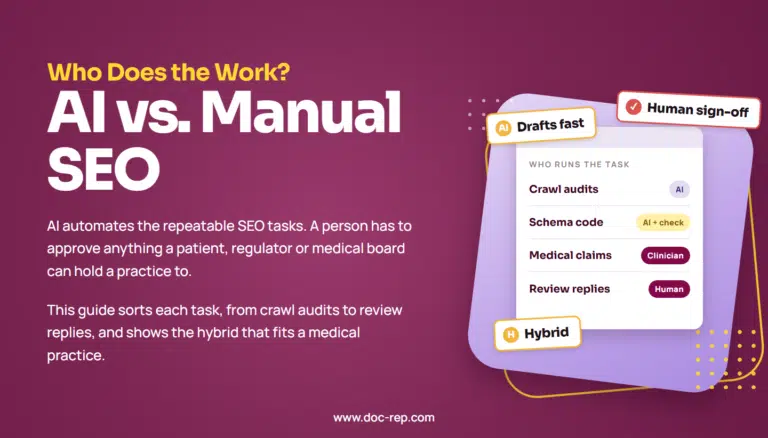
- AI drafts. Quick for outlines and first drafts. Raw AI text on a medical site fails, because the tool cannot check a drug claim or a dosage. Our piece on AI versus manual SEO explains why a person has to own every clinical sentence.
Google’s spam policy treats mass-produced pages as “scaled content abuse” whether a person or a tool made them. Fewer, better pages protect a medical site. Ten reviewed pages beat a hundred unreviewed ones.
How Do You Make Content Trustworthy to Patients and Google?
Show who wrote it, who reviewed it, what it relies on and when it was last checked. Google’s guidance says trust is the most important part of E-E-A-T, and health pages sit in the Your Money or Your Life group, where the bar is highest. Read Google’s helpful content guidance once, because it asks three plain questions: who made this, how, and why.
Named Clinician and Real Credentials
Every medical page carries an author or reviewer with a name, a license and a short bio. “Reviewed by the Doc team” proves nothing. A bio that links to the doctor’s profile page gives Google a way to connect the page to a real person.
Sources and Dates
Treatment claims link to a primary source: a guideline, a study, an FDA label. Each page shows a real last-reviewed date. A date that changes without any edit to the text is a defect.
The Claim Ladder for Treatment Language
Not every sentence carries the same risk, so each type of sentence needs a different level of proof.
| Claim | Example | What it needs |
|---|---|---|
| Regulatory fact | “Spravato is given only in certified settings.” | The FDA label, cited |
| Your own practice | “A nurse stays with each patient during monitoring.” | Your actual protocol |
| Outcome | “Patients feel relief within hours.” | A named study with the population and the result, or remove it |
Testimonials never prove an outcome claim.
Anatomy of a Strong Treatment Page
A strong treatment page answers in the first lines, then walks the patient through the decision. It opens with a direct answer to what the treatment is and who it helps. It explains how the treatment works in plain words, what a visit involves and how long a course takes. It states cost and insurance honestly, or says how to find out. It covers risks and who is not a candidate. It shows the reviewing doctor’s name, credentials and review date. It ends with one booking step. Patients and AI search tools both pull answers from pages built this way, because each section stands alone.
Privacy Lines for Stories and Reviews
A patient story used for marketing needs written authorization under HIPAA. The rule sits at 45 CFR 164.508. Replies to reviews never confirm that a reviewer is a patient. The FTC’s rule on consumer reviews and testimonials, in force since October 21, 2024, bars fake reviews, bought reviews tied to a positive rating, and review suppression. This is marketing guidance, not legal advice, and counsel reviews any patient-story program.
How Does a Reader Become a Booked Patient?
A reader books when the page gives one clear next step at the moment they are ready for it. A page without a next step produces visitors, not patients.
The Next Step on Every Page
A service page ends with a booking button and a visible way to call. A condition guide ends with a link to the treatment page that fits. A cost page ends with an offer to check insurance or book a consultation. One next step per page. Three competing buttons produce no click.
Internal Links That Move Readers
Internal links carry readers toward the booking page and tell Google which pages matter. A condition guide links to the treatment page, the treatment page links to the cost page, and every page links to the doctor profile. Our medical SEO guide explains how that structure supports rankings.
Tracking Without Exposing Patients
The booking path needs tracking, and tracking needs care. Form submissions, phone taps and appointment clicks get counted as events. No advertising pixel fires on an intake form or a confirmation page. Counsel reviews any tag that touches a page where a condition and an identifier combine.
How Does Content Marketing Fit With SEO, Ads and Reviews?
Content is the material that the other channels run on. SEO makes the pages findable, so a page nobody can find earns nothing. Google Ads send paid visitors to the same service and cost pages, and a clearer page converts those visitors better. Reviews and your Google Business Profile prove the claims a page makes, because a patient checks both before booking. Online reputation management and local SEO feed the same decision. A practice that runs these as separate projects pays for the same trust three times. One plan, with one set of pages and one tracking setup, costs less and reads clearer to a patient.
How Do You Measure Content Marketing by Bookings?
Measure content by booked appointments first, then by the numbers that lead to them. Traffic and impressions matter, but they are the early signals, not the result.
Google Search Console shows what your pages earn in search: queries, pages, impressions, clicks, click-through rate and average position. Google Analytics 4 shows what visitors do next, through key events such as form submissions, phone taps and booking clicks. Together they answer two questions: did the right people find the page, and did they act?
Read the numbers in three tiers.
- Visibility. Impressions and average position for the searches you targeted.
- Engagement. Visitors from the right cities, engaged sessions, and clicks to the next step.
- Bookings. Form submissions, calls and scheduled consultations traced to the page.
A report that stops at tier one celebrates traffic while the calendar stays thin. Our KPIs for medical practices article lists the numbers worth tracking each month.
Attribution has limits. A patient can read three pages, then search your name and call. The page that earned the trust gets no credit in a simple report. Front desk staff who ask each new patient how they found you, and log the answer, give you a check against the analytics.
How Long Does Content Marketing Take, and What Shapes the Cost?
A new page is indexed in days, rankings move over weeks to months, and steady new-patient inquiries take a few quarters of consistent work. Competition decides the speed. A solo psychiatrist in a mid-size town ranks faster than a dermatology group in a large metro.
Cost depends on responsibility, not on article count. Four drivers set the price: who does the clinical review, how deep the research goes, how many pages the plan needs, and whether the work includes measurement and updates. Most cheap quotes leave out the reviewer. A quote with no measurement leaves you unable to judge the result. Our medical SEO cost guide breaks down how to compare quotes.
Our content marketing services page shows how we scope the work, and we price it by responsibility, never by article count.
When Does an Old Page Need a Refresh?
A page needs a refresh when its facts change, when it slips in rankings, or when six months pass without a review. Content decays quietly. A guide that ranked well last year can drift to page two while a competitor publishes a newer answer.
These triggers are our working rules, not Google’s:
- Position six to twenty with real impressions. The page is close to winning, so it needs what the top results include and it lacks.
- Low click-through rate for its position. Rewrite the title and description.
- A regulatory, FDA or platform policy change. Update at once.
- Six months since the last clinical review. Re-review and re-date.
A refresh changes the content, not only the date.
How Does Content Marketing Change by Specialty?
The method stays the same, but the questions patients ask and the rules that apply change with the specialty and the payment model.
| Practice type | What patients search | What the content must handle |
|---|---|---|
| Insurance-based (TMS, psychiatry, medical dermatology) | Coverage, prior authorization, what a course involves | Plain explanations of the process; FDA-cleared indications only. See TMS clinic SEO |
| Cash-pay (ketamine, concierge, cosmetic work) | Cost, safety, who qualifies | Exact FDA status; ad-platform limits push more weight onto organic content. See ketamine clinic SEO |
| Certified-setting treatments (Spravato) | Eligibility, monitoring, comparison with IV ketamine | REMS rules and the two-hour observation period. See Spravato clinic SEO |
| Referral-driven (cardiology, ophthalmology) | Procedure and provider credentials | Content for referring doctors as well as patients |
| Urgent local care (chiropractic) | Pain relief near me, same-day booking | Speed to book; state advertising rules on claims |
For specialty clinics the FDA wording matters most. Spravato is FDA-approved, Schedule III and distributed under a REMS, with monitoring for at least two hours after each dose. Ketamine is not FDA-approved for any psychiatric disorder, and the FDA warned about compounded ketamine products in October 2023. A page that blurs the two creates risk in search and in front of a regulator.
What Does a First 90 Days Look Like for a Busy Practice?
A busy practice gets further with two strong pages a month than with eight thin ones. The plan below assumes a solo or small practice with a few hours a month for review.
Month One: Foundation
Search Console supplies the searches the site already earns, and the search-to-page map follows from them. The booking path and tracking get fixed so later results are measurable. Then the main service page and the cost and insurance page for the top treatment get written.
Month Two: Trust Pages
Publish a “what to expect” page, doctor profiles with credentials, and a location page with real directions, parking and photos. The new pages link to each other and to the service page.
Month Three: Early-Stage Readers
Two condition guides go up, each linking to the treatment pages. The first data then shows which pages earned impressions, which got clicks, and which produced a booking event. That evidence decides what gets written next.
After day ninety the work becomes a rhythm: one or two new pages a month, one refresh, one measurement review. Our digital marketing for doctors shows where content sits beside the other channels.
When Is Content Marketing the Wrong First Move?
Content marketing is the wrong first move when the website cannot take a booking, when the practice needs patients within weeks, or when no one can review medical claims.
A site with a broken booking form wastes every visitor, so website design comes first. A new practice with an empty schedule needs ads and referrals now and content alongside. A practice with no clinician time for review waits, or limits itself to cost, process and doctor pages, which carry less clinical risk. Honest sequencing beats a plan that looks complete and stalls.
Final Thoughts
Content marketing for a medical practice is slow, honest work, and that is why it lasts. Ads stop when the budget stops. A reviewed page that answers a real worry keeps working long after we publish it.
We keep coming back to the same few rules. The pages closest to a booking come first. A clinician’s name stands behind every medical claim. Each page carries one next step. Booked appointments, not traffic, judge the work. A practice that holds to those four rules will beat one that publishes twice as much and reviews nothing.
You do not need a hundred posts to start. You need the pages your next patient is already searching for, written plainly by people who know the specialty.
Frequently Asked Questions
How many blog posts does a medical practice need each month?
There is no magic number. Two reviewed, well-researched pages a month beat eight thin posts. Quality, clinician review and a clear next step on each page decide results. Publish more only when the review process can keep up.
Can I use ChatGPT to write content for my practice?
ChatGPT works for outlines and first drafts, never for final medical copy. AI tools cannot verify drug claims, dosages or regulatory status. A clinician must review every clinical sentence before publishing, and the page carries that reviewer’s name.
Is content marketing better than Google Ads for a medical practice?
They do different jobs. Ads bring patients quickly and stop when the budget stops. Content builds trust and traffic that compound over months. Most practices need both, with ads covering the early gap while content builds.
Does content marketing help my practice appear in AI search answers?
Yes, through the same fundamentals. Google says a page needs to be indexed and eligible to show a snippet, with no special markup. Clear answers near the top, named reviewers and consistent facts help. Read our guide on SEO versus GEO for detail.
Do patient stories break HIPAA?
They can. Using a patient’s information in marketing needs written authorization under 45 CFR 164.508. Many practices skip named stories and use anonymous, process-focused case descriptions instead. Have counsel review any story program.
References
- Google Search Central, Creating helpful, reliable, people-first content (E-E-A-T; Who, How and Why).
- Google Search Central, AI features and your website (indexing and snippet eligibility).
- Google, Search Quality Rater Guidelines (Your Money or Your Life pages).
- Federal Trade Commission, Trade Regulation Rule on the Use of Consumer Reviews and Testimonials, 16 CFR Part 465 (effective October 21, 2024).
- US Food and Drug Administration, Spravato (esketamine) prescribing information and REMS. Accessed November 2026.
- US Food and Drug Administration, FDA warns about compounded ketamine products for psychiatric disorders (October 10, 2023). Accessed November 2026.

Medical & Healthcare SEO Expert focused on turning search visibility into booked patients and revenue. Specialties: technical SEO, schema and LLM visibility, AI SEO/GEO, and local search for clinics.
All articles by Atiur RahmanBook a free 30-minute strategy call and we’ll show you where the biggest opportunities are.