The question comes up in nearly every conversation I have with physicians and clinic directors about SEO: should we hand the work to autonomous AI software, or keep doing everything by hand?
If you want the honest answer upfront: don’t hand a medical site’s SEO to pure AI, and don’t avoid AI either. A clinically supervised hybrid works.
You must not skip using AI. If someone tells you never to touch AI, they are living in 2012. Using AI is not the issue; the issue is using AI without knowing its impact, without knowing where AI must never touch your patients, and without knowing when you must pull the plug on automation.
What Happened When One Medical Site Went 100% AI?
I have spent over 13 years working in SEO, with several years focused specifically on healthcare, specialty medical clinics, and practice growth. I do not speak from theory.
I have tested, deployed, and dissected automated AI SEO tools, autonomous ranking bots, and agentic AI systems in depth. I know their architectures, their prompt pipelines, and their API limits.
More importantly, I have seen the real-world fallout firsthand.
Over the past two years, I watched several practices in various niches, along with medical clinics, get lured in by cheap automated AI SEO tools. They thought they could press a button, publish 50 pages a week, and outrank established competitors while slashing marketing overhead. I personally monitored their performance inside Google Search Console.
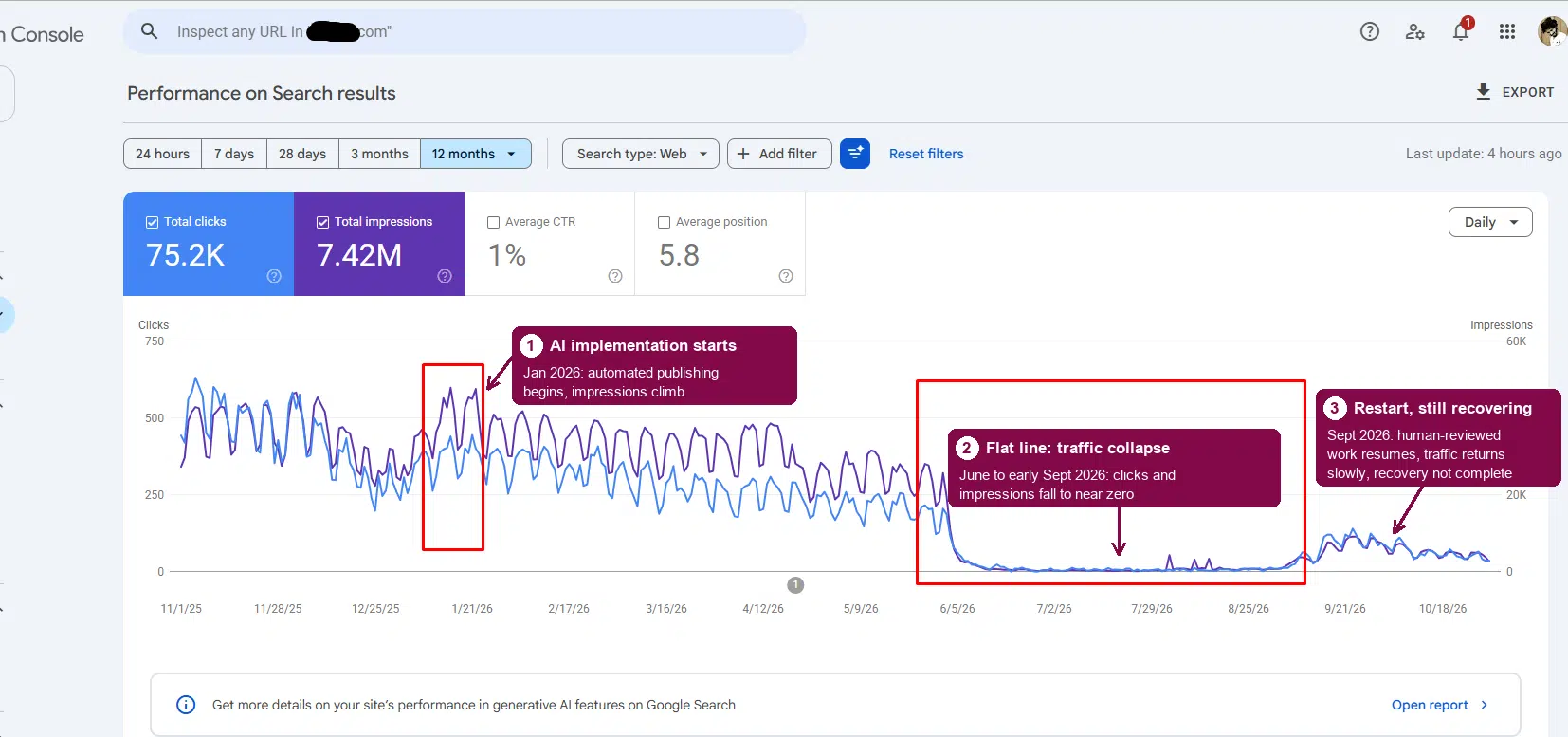
The chart below is one site that went heavily automated. Impressions climbed for a few weeks in January 2026, then fell to a flat line from June to early September. We restarted with human review in September, and traffic is slowly coming back. The site is still in recovery.
What Does AI Automated SEO Actually Do for a Medical Practice?
Automated SEO refers to software platforms, programmatic scripts, and artificial intelligence models that execute search optimization tasks with minimal direct human labor.
In a healthcare setting, automated SEO tools generally attempt to handle five core operations:
- Automated Content Generation: Large Language Models (LLMs) draft condition overviews, procedure descriptions, and patient education blog posts based on keyword prompts. Programmatic SEO tools can generate dozens of localized landing pages targeting specific zip codes or suburban service areas.
- Automated Technical Auditing: Crawlers continuously scan your website to detect broken links, missing image alt attributes, slow server response times, and SSL certificate expiration.
- Automated Metadata and Tagging: Natural language algorithms analyze page copy and automatically insert title tags, meta descriptions, header structures, and internal links across hundreds of URLs simultaneously.
- Automated Structured Data Markup: Code generators create Schema.org JSON-LD scripts (such as MedicalClinic, Physician, and MedicalProcedure) to help search engines parse your physical location, accepted insurance plans, and clinical services.
- Automated Review and Listing Syndication: Centralized aggregators sync your clinic’s Name, Address, and Phone number (NAP) across third-party directories like Healthgrades, WebMD, Yelp, and Google Business Profile, while automated bots draft generic replies to incoming patient reviews.
Automation saves time on repetitive technical chores. Used on clinical copy and patient communication with no supervision, it creates real risk.
What Does Manual SEO Execution Cover in Healthcare?
Manual SEO relies on dedicated human professionals: healthcare SEO strategists, medical copywriters, technical web developers, and clinical reviewers who hand-craft and verify every asset on your website.
Manual healthcare SEO execution covers critical areas that software algorithms cannot navigate:
- Clinical Accuracy and Medical Consensus: Human writers research peer-reviewed medical journals (such as PubMed, JAMA, and NEJM) to ensure every treatment explanation, clinical trial citation, and recovery timeline aligns with established medical consensus.
- Physician E-E-A-T Attribution: Specialists build verifiable clinical authority signals by linking provider profiles to active National Provider Identifier (NPI) records, state medical board licenses, hospital affiliations, published research, and professional association memberships.
- Bedside-Manner Empathy and Patient Psychology: Experienced healthcare writers understand the emotional vulnerability of prospective patients seeking specialized care. Copy is crafted to relieve anxiety, explain complex medical jargon in clear language, and guide visitors toward booking a consultation.
- HIPAA awareness: people review forms, scheduling widgets and tracking tags so patient information stays protected.
Manual work gives you strong quality control. Its limit is capacity: writing, vetting and publishing four medical guides a month takes real coordination.
Head-to-Head Comparison: Automated SEO vs. Manual SEO
The table below contrasts pure automated SEO software, traditional manual agency execution, and the clinically supervised hybrid model across the factors that decide practice growth.
| Feature / Dimension | Pure AI Automated SEO | Traditional Manual Agency SEO | Clinically Supervised Hybrid Model |
|---|---|---|---|
| Primary Execution Method | Software and scripts do the work on their own | People do the work: strategists, writers and developers | Software handles technical tasks. Specialists handle clinical content and strategy |
| Publishing Speed | Minutes. Dozens of pages a day | Weeks. 1 to 4 articles a month | Days. Fast drafts, then clinical review before anything is published |
| Typical Monthly Cost | $99 to $500 a month (software subscription) | $2,500 to $6,000+ a month (agency retainer) | From $999 a month (specialized healthcare partner) |
| Clinical Accuracy | Weak. Can invent medical facts and cannot check them | Strong when the writer has healthcare experience | Strong. A specialist verifies it before publishing |
| Google Algorithm Risk | High risk. Mass-produced pages can fall under Google’s spam policy | Low risk. Steady, compounding organic authority | Lower risk. Technical schema plus verified E-E-A-T |
| HIPAA and Legal Safety | High risk. Auto-reply bots can reveal that someone is a patient | HIPAA-aware. People review legal, privacy and brand issues | HIPAA-aware. A person reviews every patient-facing workflow |
| Physician E-E-A-T Depth | Weak. Cannot create real clinical credentials | Strong. Writers structure real licenses, bios and affiliations by hand | Strong. Code structures the physician profile, and a specialist verifies the copy |
| Local Map Pack Impact | Minimal. Cannot build local relationships or earn referring-doctor links | Strong. Builds local relationships and citations | Strong. Software monitors directories, and people handle outreach |
| AI Search Citations (GEO) | Poor. Generic text gives AI assistants little to cite | Moderate. Accurate content, but often lacks entity schema | Strong. Structured entity data plus verified expert text |
| Best Fit for Practices | Non-medical hobby blogs and basic technical checks | Organizations with large marketing budgets and in-house teams | Independent practices, specialty clinics and private groups |
Why Fully Automated AI SEO Is a Poor Fit for Healthcare Providers
In many business sectors, a flawed automated blog post simply fails to rank. In medicine, publishing unvetted automated copy can trigger severe regulatory penalties, devastate search traffic, and expose your clinic to legal action.
1. Google YMYL Standards and Devastating Core Update Penalties
Google holds health pages to its highest quality bar, called Your Money or Your Life (YMYL), because medical advice affects a patient’s health, money and mental wellbeing.
Google’s Search Quality Rater Guidelines explicitly instruct evaluation algorithms to look for clear evidence of human expertise, real-world clinical experience, and authoritative sourcing. When a practice floods its domain with automated text, Google’s automated helpful content systems detect the lack of clinical depth.
When Google detects hundreds of medical pages published under a single domain without verifiable physician authorship, the entire domain loses its topical authority score.
2. Clinical Hallucinations and Medical Malpractice Exposure
Large Language Models do not possess medical comprehension. They are statistical pattern-recognition engines designed to predict the next most probable word in a sentence. When an AI model lacks precise source data, it fabricates statements with absolute grammatical confidence, a phenomenon known in computer science as hallucination.
In specialty healthcare, clinical hallucinations represent catastrophic liabilities:
- Ketamine Therapy: An automated article might conflate intravenous clinical infusions with recreational use, state incorrect dosing protocols, or fail to disclose hypertension contraindications.
- TMS Therapy: An automated post might claim that transcranial magnetic stimulation is a permanent cure for chronic depression with zero risk of seizure, violating FDA clearance language and misleading vulnerable patients.
- Dermatology: An unreviewed AI article might provide incorrect rules for distinguishing benign seborrheic keratosis from malignant melanoma, leading an anxious patient to delay life-saving clinical evaluation.
- Aesthetic Medicine: Automated copy frequently misstates Botox units, recovery downtime, or contraindications for pregnant patients.
If a patient acts on automated medical content published under your name and is harmed, the exposure is yours.
3. HIPAA Privacy and FTC Review Compliance Violations
Some SEO vendors bundle bots that answer Google reviews instantly. That’s a privacy problem. Confirming that someone is your patient can count as disclosing protected health information under HIPAA, which HHS OCR enforces.
Example: a patient writes, ‘Dr. Smith helped me with my severe depression.’ A bot replies, ‘Thank you, John! We’re so glad our depression treatment helped. See you at your next therapy session!’ That reply confirms the condition, the treatment and a future appointment.
4. The Local Map Pack Deficit (AI Cannot Fake Local Trust)
Automated AI tools cannot win competitive map pack rankings. Google’s local algorithm prioritizes three primary factors: Relevance, Distance, and Prominence.
AI can’t call a hospitalist group to set up a referral partnership, sponsor a local charity, land a newspaper mention or get your front desk to collect specific, real reviews.
Automated tools can assist with technical data formatting, but winning local search requires human execution in your physical market.
Where, How, and When to Use AI in Healthcare SEO
Use AI in medical SEO exactly as you use an automated clinical analyzer or an AI imaging assistant in radiology: to process massive volumes of raw diagnostic data rapidly, but never to sign a treatment plan or discharge a patient without an attending physician.
Here’s how I sort the tasks:
Where Should You Use AI?
Use AI on the foundational, data-heavy, mechanical tasks of search optimization:
- Technical Crawl Hygiene: Running automated scripts to detect 404 crawl errors, broken internal redirects, slow server response times, and missing image attributes across hundreds of URLs.
- Entity Schema Formatting: Generating complex JSON-LD structured data code blocks for MedicalClinic, Physician, and MedicalProcedure to ensure search engines parse your NPI numbers, accepted insurances, and physical addresses accurately.
- Search Query Clustering: Analyzing tens of thousands of natural language search queries to uncover conversational patient questions.
How Should You Use AI?
Use AI strictly as a research accelerator and structural scaffolding tool:
- Generate comprehensive topic outlines based on top-ranking clinical pages.
- Summarize non-clinical public data sets, such as regional census statistics or insurance terminology glossaries.
- Never use AI as a push-button publisher. The output of an AI model should only ever be treated as raw research notes for a human healthcare copywriter.
When Must You Pull the Plug on AI?
You must immediately stop using AI automation whenever a task touches:
- Treatment Descriptions and Clinical Protocols: Any explanation of how a medication works, what a surgical procedure involves, or what diagnostic criteria apply.
- Physician Credentials and E-E-A-T Proof: Author bylines, medical license numbers, board certifications, and clinical experience claims.
- Patient Review Responses: Any communication on Google Business Profile, Yelp, or Healthgrades where a patient mentions their care.
- Outcome Guarantees and Ad Claims: Any statement that touches FDA regulatory boundaries, state medical board advertising ethics, or FTC endorsement rules.
The Safe vs. Dangerous Healthcare SEO Task Matrix (The Checkability Rule)
The rule is simple: automate any task whose output you can verify against an objective fact, and keep an experienced human on any statement that a patient, medical board, or regulator can hold you to.
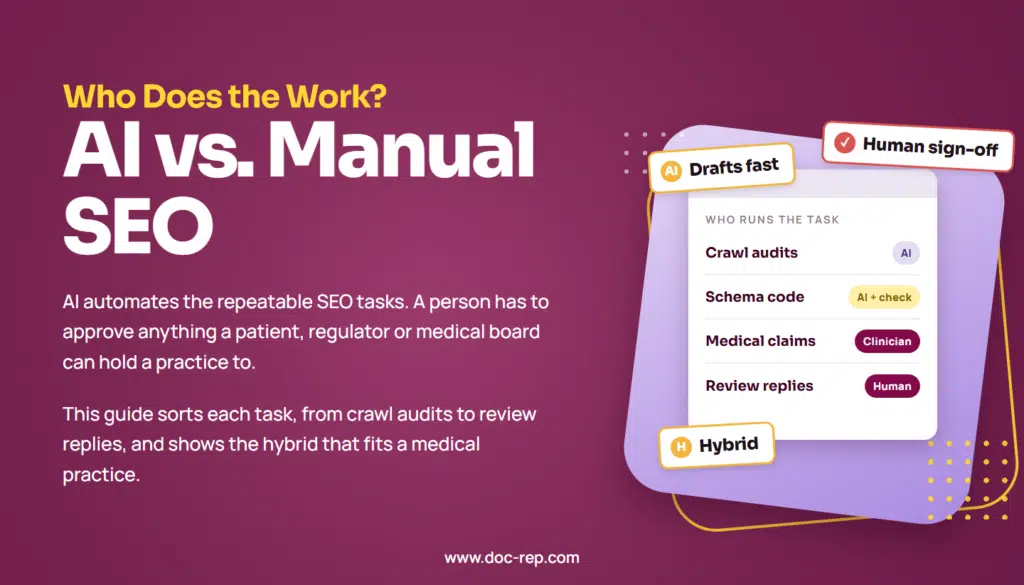
I call this the Checkability Rule. It replaces vague marketing promises with an objective test you can apply to every single task in an SEO contract: a crawl audit passes the test because a link returns a 404 or it does not; a sentence describing candidate selection for ketamine fails the test because only a clinician can verify clinical safety.
| Healthcare SEO Task | Who Runs It | Why It Belongs There |
|---|---|---|
| Technical Crawl Audits | Automation | Every 404 error, redirect chain, and server response time is a checkable fact. |
| Search Query Clustering | Automation | Software clusters thousands of Search Console export rows into intent themes. |
| Schema Markup Generation | Automation drafts, Human verifies | Software formats JSON-LD code; a human verifies doctor licenses and NPI numbers. |
| Rank & Traffic Monitoring | Automation | Tracking rankings and impressions across cities is purely mechanical reporting. |
| Directory NAP Consistency | Automation finds, Human approves | Software identifies address mismatches; a human approves edits to avoid bad directory data. |
| Meta Title & Description Drafts | AI drafts, Human edits | AI provides character-counted options; a human ensures claims match medical ethics. |
| Clinical Content Outlines | AI drafts, Specialist refines | AI identifies competitive topic structures; a specialist tailors headings to clinic services. |
| Service Page & Blog Copywriting | Human Healthcare Writer | Translating clinical data into empathetic, patient-centered prose requires human nuance. |
| Medical Accuracy Review | Licensed Clinician / MD | Every drug, device, dosage, and outcome statement requires professional sign-off. |
| Physician E-E-A-T Credentialing | Human Specialist | Linking verified medical licenses, hospital affiliations, and PubMed citations requires human care. |
| Patient Review Replies | Human Specialist | Every response must be individually crafted to prevent HIPAA disclosures of patient care. |
| Patient Testimonials & Stories | Human with Written HIPAA Release | 45 CFR 164.508 requires formal written patient authorization for marketing uses of PHI. |
Does Google Actually Penalize AI Content in Healthcare?
No. Google doesn’t penalize content for being written by AI. It targets content mass-produced to manipulate rankings, whoever or whatever wrote it.
Google’s spam policy defines scaled content abuse as many pages generated ‘for the primary purpose of manipulating search rankings and not helping users’, no matter how they are created.
Notice what Google explicitly left out of that rule: it does not ban artificial intelligence. It does not protect human writers who produce low-quality fluff either.
In non-medical industries, an unreviewed AI article that ranks is a win. For a medical site, ranking isn’t the real risk. A page can reach page one and still give a patient the wrong information about a medication or a doctor’s credentials. The penalty that matters comes from a licensing board, an ad regulator or a harmed patient, not from Google.
How We Use AI at Doc-Rep: Machine Speed Backed by Healthcare Specialists
At Doc-Rep, we actively use artificial intelligence every single day to eliminate repetitive technical grunt work, but behind every single AI task sits a human specialist with dedicated healthcare SEO and medical policy experience.
We do not hide our use of technology.
When you work with Doc-Rep:
- AI handles the heavy data lifting: Our automated tools scan your website’s technical code, map competitor keyword gaps across your metropolitan area, and format structured schema.
- A healthcare SEO veteran directs the strategy: A healthcare SEO specialist leads the strategy. They know medical terminology, cash-pay versus insurance patients, and how state boards regulate doctor advertising.
- Every medical claim is fact-checked: We never publish raw AI drafts. Every medical claim is fact-checked against peer-reviewed sources and your clinic’s actual protocols before it goes live.
The True Cost Equation: Software Subscriptions vs. Practice Recovery
A $200 monthly automated SEO subscription is not cheap when you spend 15 hours of clinical billing time editing bad text and $10,000 recovering from a Google spam penalty.
Many clinic owners look at a $250 software fee and think they are saving thousands of dollars compared to a specialized agency retainer. When you factor in the physician’s hourly clinical value and the cost of fixing damaged domains, the math reverses completely.
| Operating Cost Component | Pure AI Automated Software | Traditional Manual Agency | Doc-Rep Supervised Hybrid |
|---|---|---|---|
| Annual Retainer / Software Fees | $3,000 ($250 / month) | $48,000 ($4,000 / month) | $18,000 ($1,500 / month)* |
| Physician Hours Spent Editing | 180 hours / year ($36,000 clinical value)** | 24 hours / year ($4,800 clinical value) | 24 hours / year ($4,800 clinical value) |
| Technical Code & Webmaster Support | Billable separately ($3,600 / year) | Included in retainer | Included in monthly service |
| Algorithmic Penalty Cleanup Cost | $5,000 to $15,000 (when hit by Core Updates) | $0 (virtually zero penalty risk) | $0 (clean, compliant architecture) |
| Total Real Annual Investment | $47,600 to $57,600 | $52,800 | $22,800 |
| New Patient Inquiries Generated | Minimal (unindexed or thin rankings) | Steady (consistent qualified inquiries) | Compounding (high local map & search rank) |
*Reflects standard ongoing specialized healthcare partner pricing following our $499 Trial Month.
**Assumes a physician clinical billing value of $200 per hour spent manually fixing inaccurate AI text, fixing formatting, and troubleshooting software tools.
A cheap subscription isn’t cheap when a physician spends hours fixing its output, a developer repairs its errors and the site needs cleanup after a traffic drop. The number that matters is booked consultations, not impressions.
Decision Matrix: How to Choose the Right Strategy for Your Clinic
The right SEO model depends directly on your clinical risk exposure and patient lifetime value: high-ticket cash-pay clinics and mental health practices must use a clinically supervised partner, while high-volume primary care can rely on automated local technical health. Match your practice profile against the framework below:
| Practice Profile & Specialty | Recommended SEO Model | Strategic Justification |
|---|---|---|
| High-Ticket Cash-Pay Clinic (TMS, Ketamine, Med Spa, Plastic Surgery) | Clinically Supervised Hybrid Partner | Patient conversion requires deep clinical authority, empathetic objection handling, and pristine doctor reputation. |
| High-Volume Insurance Clinic (Dermatology, Chiropractic, Pediatrics) | Hybrid Model (Local & Map Pack Focus) | Automated technical citation scanning combined with human Google Business Profile review management. |
| Multi-Location Specialty Group / MSO (5 to 15+ physical offices) | Specialized Agency Partner with Dedicated Teams | Requires automated programmatic location schema paired with experienced human healthcare strategists. |
| Solo Practice with Limited Launch Capital (Newly opened clinic) | Manual Founder-Led SEO (DIY + Free Tools) | Better for the founding doctor to write 5 authentic clinical guides manually than to risk domain ruin with cheap AI bots. |
Red Flags When an Agency Sells You “AI SEO”
If an agency says AI can run your SEO without your clinical input, or promises dozens of articles for under $500 a month, treat it as a warning.
If an agency pitches you, watch for these five warning signs:
- Any vendor claiming that their automated software can run your medical SEO entirely without your team’s clinical input is selling dangerous shortcuts that violate Google’s YMYL guidelines.
- Dozens of posts for under $500 a month. Quality medical content needs experienced writers and clinical review.
- No named writers or review process. Ask who writes your medical copy, what their healthcare background is and how accuracy gets checked.
- If an agency’s platform automatically publishes generic replies to patient reviews on your Google Business Profile without human review, cancel the contract immediately to avoid catastrophic HIPAA violations.
- No ownership of your site, code or analytics. Insist on admin access to your domain, WordPress and Search Console.
Final Thought
Using AI is not the problem: using AI blindly without clinical guardrails is.
Medicine runs on trust. An algorithm can’t comfort an anxious patient or take responsibility for clinical accuracy.
Automate the mechanical grunt work, but keep experienced human specialists guarding your clinical voice, your medical license, and your patient relationships.
If you are currently evaluating an automated SEO tool, or if your practice suffered a traffic drop after using unvetted AI content, book a free strategy call with me and the Doc-Rep team. We will audit your Search Console performance, check your domain health, and show you how a clinically supervised hybrid program can safely grow your clinic.
You can also experience our supervised process directly on your own site through our Trial Month: one doctor, one location, and one core service with no setup fees and no long-term contracts.
Frequently Asked Questions
Can Google detect AI-written medical content and penalize it?
Google doesn’t penalize content for being written by AI. It targets low-value pages produced at scale, and health pages face a higher quality bar. A named physician reviewer is your safest signal.
Is automated AI SEO cheaper than hiring a medical marketing agency?
The subscription is cheaper. The total isn’t always, once you add physician time fixing drafts and cleanup after a traffic drop. Compare scope and review, not only the invoice.
Can I use ChatGPT to write blog posts for my medical practice?
Yes for outlines and research, no for publishing. A licensed clinician must verify every treatment, diagnosis and outcome statement before it goes live.
What is the difference between AI Automated SEO and Generative Engine Optimization (GEO)?
AI automated SEO means software does the SEO tasks. GEO (or AEO) means optimizing your site so ChatGPT, Gemini, Perplexity and AI Overviews cite you. One is a method, the other a goal.
Does Doc-Rep use automated AI tools or manual SEO execution?
Both. Software handles technical audits, monitoring and schema. Specialists write, fact-check and approve every clinical page, and no raw AI draft goes live.
References
- Google Search Central, Spam policies for Google web search (scaled content abuse). Accessed November 2, 2026.
- Google Search Central, Guidance on using generative AI content on your website. Accessed November 2, 2026.
- Ahrefs, AI-Generated Content Does Not Hurt Your Google Rankings (600,000 Pages Analyzed), published July 7, 2025. Accessed November 2, 2026.
- Google, Search Quality Rater Guidelines (YMYL and E-E-A-T sections). Accessed November 2, 2026.
- eCFR, 45 CFR 164.508, Uses and disclosures for which an authorization is required. Accessed November 2, 2026.

Medical & Healthcare SEO Expert focused on turning search visibility into booked patients and revenue. Specialties: technical SEO, schema and LLM visibility, AI SEO/GEO, and local search for clinics.
More from AtiurBook a free 30-minute strategy call and we’ll show you where the biggest opportunities are.