SEO for doctors is a specialized form of search engine optimization that helps medical practices rank on search engines like Google and attract patients actively searching for symptoms, treatments, and local providers.
When someone types “knee doctor near me,” SEO determines whether they find you or your competitor. This is a massive opportunity.
Hema Budaraju, VP of Product Management for Google Search, shared at The Check Up 2026 that Google handles over one billion health-related searches every day. Patients are actively looking; the question is whether they find you.
SEO is simply the process of making sure they do. It helps your website appear when patients search, so search engines like Google can match your services with the right people at the right time.
As health-related searches impact real health decisions, Google treats these websites as YMYL (Your Money or Your Life). That means your visibility depends heavily on E-E-A-T: Experience, Expertise, Authoritativeness, and Trustworthiness.
If that sounds complicated, don’t worry.
This guide walks you through every piece of the puzzle of SEO for Doctors. We will cover what Medical SEO actually is, how to pick the right keywords, how to set up your website, and how to get more patients finding you online, all without drowning in technical jargon.
How SEO Brings Patients to Doctors
SEO brings patients to your practice by matching what they search with what you publish. It helps your website appear when people look for symptoms, treatments, and doctors. Instead of chasing patients, SEO positions your practice in front of them at the exact moment they need help.
- Stage 1: Symptom search: A patient notices something wrong and searches for answers. They type queries like “sharp pain in lower back” or “red bumps on arms that won’t go away.” At this point, they are not looking for a doctor. They want to understand the problem.
- Stage 2: Treatment search: The patient now has a basic idea of the condition. They start exploring solutions. They search for “physical therapy for sciatica” or “best treatment for eczema.” They compare options and learn what might help.
- Stage 3: Doctor search: The patient is ready to take action. They search for terms like “spine doctor near me” or “dermatologist in Dallas accepting new patients.” This is where your practice needs to appear.
Some patients skip directly to the third stage, especially for routine care like teeth cleaning or a yearly skin check. Many others move through all three stages. If your website covers each stage, you reach patients earlier and guide them toward booking.
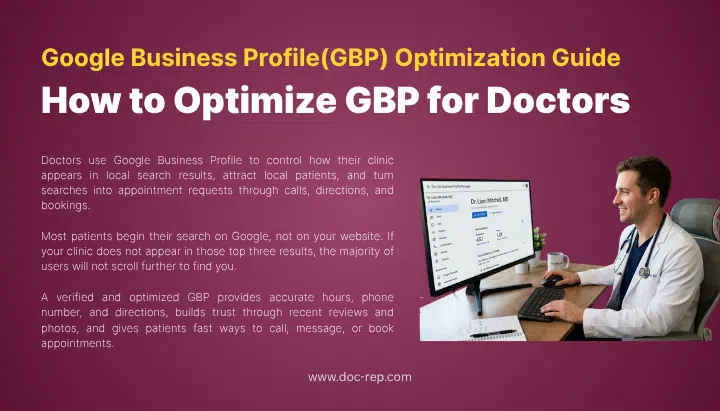
Google Maps results play a major role here. The top three listings (Google Map Pack) often get most of the clicks. Patients trust these results because they can quickly see ratings, hours, and location. Your Google Business Profile is often the first impression they get of your practice.
Why Is SEO Important for Doctors & Medical Practices?
SEO brings patients to your door without paying for every single click. Once your website ranks well, it works around the clock, bringing in new patients at 2 AM on a Sunday just as effectively as at 10 AM on a Tuesday.
- Cost Savings: The average cost per click for medical keywords on Google Ads runs between $3 and $12. Competitive terms like “plastic surgeon near me” can cost over $25 per click. If your website gets 500 organic clicks per month for that keyword, you are saving $12,500 or more in advertising costs every month. That is real money staying in your practice.
- Builds Trust: Patients see top search results as more credible. When your practice appears first for “best cardiologist in Houston,” patients view that as a strong signal of authority, even though rankings come from an algorithm, not a human editor.
- Intent-Based Patient Reach: Someone searching “what causes recurring migraines” needs an educational article. Someone searching “migraine specialist accepting new patients in Chicago” needs your booking page. You can create pages for both and guide each person toward becoming your patient.
- Local Search Dominance: SEO helps you show up where most patients make decisions. When someone searches “dentist near me” or “dermatologist in Miami,” Google shows a limited set of local results. If your practice appears there, you capture patients who are ready to book, not just browsing.
- Compounds Over Time: Unlike ads that stop the moment you turn off the budget, a well-optimized page can bring in traffic and patients for months or even years. The effort you invest today continues to generate results long after the work is done.
- Reduced Dependency on Ads: Ad costs increase, and competition grows. SEO gives you a stable, owned source of patient acquisition that you control, reducing your reliance on paid channels.
Why Most Doctors Struggle to Get Patients from Google
Most doctors struggle to get patients from Google because they lack visibility, do not build enough trust, and face strong competition.
- Visibility problem: Most medical websites do not rank on page one. If your practice does not show up, patients will not find you. Even a well-designed website fails if Google cannot see it or trust it.
- Competition: You are not just competing with other clinics. You are competing with hospital systems, large health networks, and authoritative sites. These players publish massive amounts of content and dominate search results.
- YMYL pressure: Healthcare falls under Your Money or Your Life standards. Google holds medical content to a higher level of accuracy and trust. Thin or generic content will not rank.
- Lack of E-E-A-T signals: Google looks for Experience, Expertise, Authoritativeness, and Trustworthiness. Many doctor websites do not clearly show credentials, real experience, or patient trust signals like reviews and testimonials.
- Weak content strategy: Most practices only create service pages like “knee pain treatment.” They ignore symptoms and educational content. This means they miss patients in earlier stages of the search journey.
- Poor local SEO setup: Many clinics do not fully optimize their Google Business Profile. Missing categories, inconsistent information, or low reviews reduce visibility in map results.
- Technical SEO issues: Slow websites, broken pages, and poor mobile experience hurt rankings. If Google cannot crawl or load your site properly, it will not rank it.
- Inconsistent online presence: Different phone numbers, addresses, or clinic names across directories confuse Google. This weakens your local authority and trust.
- No review strategy: Patients rely heavily on reviews. A practice with few or outdated reviews loses trust quickly, even if the medical care is excellent.
- No conversion focus: Even when traffic comes in, many websites fail to convert. Missing clear calls to action, confusing navigation, or no easy booking option leads to lost patients.
What Makes Medical SEO Different From Regular SEO?
Three things make medical SEO unique compared to, say, a restaurant or clothing store trying to rank on Google.
- YMYL scrutiny. Google holds your website to a higher standard. A pizza shop can rank with basic content. A medical website needs to prove that qualified professionals are behind the information. Inaccurate health content can cause real harm, and Google knows that.
- HIPAA compliance. You cannot use patient stories, treatment details, or before-and-after photos without proper written consent. This limits some marketing tactics that work great for other businesses. You have to be more careful and creative with your approach.
- Credential verification. Google rewards medical websites that clearly show doctor credentials, board certifications, hospital affiliations, and published research. Your “About the Doctor” page is not just a nice touch; it actually helps you rank higher.
Example: An orthopedic practice that displays each surgeon’s fellowship training, board certifications, and hospital privileges on its website gives Google exactly what it wants to see. A competing practice with a generic “Meet Our Team” page and no credentials listed will struggle to match those rankings.
Core Components of Medical SEO
Medical SEO is not one tactic; it is a system. Each component works together to help your practice show up when patients search, build trust once they land, and convert that visibility into actual appointments. When one part is weak, the whole strategy underperforms. Below are the core components that make a medical SEO strategy work in real practice settings:
- Keyword Research: Understanding what patients are searching for and mapping those queries to services, treatments, and conditions your practice offers.
- Technical SEO: Ensuring Google can crawl, index, and understand your website without errors, speed issues, or structural barriers.
- On-Page SEO: Optimizing content, keywords, and structure of each page so search engines and patients clearly understand what each page is about.
- Content Strategy: Building authority through educational articles, service pages, and condition-based content that matches every stage of the patient journey.
- Off-Page SEO: Building authority through backlinks, citations, and reputation signals that strengthen trust in your website across the web.
- Local SEO: Improving visibility in Google Maps and “near me” searches so your practice shows up when patients are ready to book locally.
In the sections below, we will break down each of these components step by step and explain exactly how to implement them for a medical practice.
Keyword Research for Doctors
Keyword research for doctors is figuring out what words and phrases your potential patients type into Google. This is the foundation of everything else in SEO.
The most important rule: Focus on patient intent, not just how many people search for something. A keyword with 10,000 monthly searches that has nothing to do with your specialty wastes your time. A keyword with 200 searches that perfectly matches what you do can bring in patients who are ready to book.
Organize your keywords by how ready the patient is to take action:
- High intent: “knee replacement surgeon Dallas” or “dentist accepting new patients near me.” These people want to book. Create service pages and booking pages for these.
- Medium intent: “ACL surgery recovery time” or “Invisalign vs braces cost.” These people are comparing options. Create detailed treatment and condition pages for these.
- Low intent: “Why does my knee hurt?” or “signs of sleep apnea.” These people are just learning. Create blog posts and educational content for these. They may not book today, but they will remember you when they are ready.
Tools that help: Semrush and Ahrefs let you see how many people search for a keyword, how hard it is to rank for, and who currently ranks. Google Search Console (free) shows you which searches already bring visitors to your site. Google Keyword Planner (free with a Google Ads account) gives volume estimates.
How Do You Choose the Right Keywords for Your Practice?
Start simple. Write down every service, procedure, treatment, and condition you handle. Then add your city or neighborhood to each one.
“Cardiologist” by itself is too broad. “Cardiologist in Atlanta” or “heart doctor Buckhead” is something you can actually rank for.
Next, spy on your competitors. Tools like Ahrefs/Semrush let you see exactly which keywords competing practices’ websites rank for. This shows you where you can compete and reveals terms you might have missed.
Be realistic about what you can win. A brand-new website will not outrank the Mayo Clinic for “heart disease symptoms.” But it absolutely can rank for “interventional cardiologist in [your city]” with focused effort over three to six months.
A tip most practices miss: Patients often search using everyday language, not medical terms. They type “red itchy bumps on arms that won’t go away” instead of “chronic urticaria.” Creating content that matches how patients actually describe their symptoms captures traffic that more clinical pages completely miss.
Even though modern search engines are much smarter and can understand contextual meaning, it still matters. Writing in the language your patients use improves relevance, increases click-through rates, and makes your content easier to understand, helping you attract and convert more patients.
On-Page SEO for Doctors
On-page SEO for Doctors is about everything you directly control on your website, including titles, headings, content, images, and links. It is the fastest way to improve rankings because you can fix and optimize it without relying on external factors.
Every page should serve one clear purpose. A service page explains a treatment, a condition page explains symptoms and care, and a blog post answers a specific patient question. When each page is focused, both Google and patients understand it better.
Use this checklist before publishing or updating any page:
- Choose one primary keyword per page based on real patient searches
- Write a clear, keyword-focused title tag (under 60 characters with location)
- Use a strong H1 headline that matches what the patient is searching for
- Create a compelling meta description that highlights benefits and drives clicks
- Keep your URL short and readable with your main keyword included
- Place keywords naturally throughout the content without forcing them
- Write high-quality, patient-friendly content that actually answers questions
- Structure content with clear headings to improve readability and flow
- Add internal links to related pages like services, blogs, and doctor profiles
- Use relevant visuals where needed to improve engagement and understanding
Your title tag is the most important on-page signal. It is the blue link people click in search results. If it is vague, you lose both rankings and clicks.
Strong example:
“Knee Replacement Surgery in Dallas | Dr. Smith Orthopedics.”
Weak example:
“Welcome to Our Practice”
Meta descriptions do not directly impact rankings, but they directly impact clicks. Think of them as your pitch in search results. Keep them clear, benefit-driven, and action-oriented.
A strong medical service page is where SEO turns into actual patients. It should clearly explain the treatment, what patients can expect before and after, recovery details, your experience, and how to take the next step. That next step, calling, booking, or contacting, should be obvious and easy.
Avoid thin content. A short page with little detail will not rank or convert. Strong pages go deeper, covering patient concerns, procedure details, risks, and eligibility in a clear and structured way.
Finally, connect your pages. Link service pages to related blog posts, blog posts back to services, and everything to your doctor profile. This builds a strong internal structure that signals authority and helps patients navigate your site easily.
Technical SEO for Doctors & Medical Practices
Technical SEO makes sure Google can actually find, read, and understand your website. Even the best content will not rank if Google cannot access it properly. Below are the key elements of Technical SEO for Doctors & medical websites.
Here are the core elements of Technical SEO, explained in a way that connects directly to how patients experience your website:
Website Speed (Core Web Vitals)
Website speed determines how quickly your pages load and respond when someone interacts with them. If your site is slow, patients leave before it even finishes loading, and Google lowers your rankings. Most medical websites slow down because of large images, poor hosting, or heavy design elements. Improving speed often leads to quick ranking and conversion gains. You can test this using Google PageSpeed Insights to see exactly what needs fixing.
Mobile Optimization
Google evaluates your website based on its mobile version first. Since most healthcare searches happen on phones, your site needs to load quickly, display clearly, and be easy to navigate with one hand. If users have to zoom, wait, or struggle to tap buttons, they leave and choose another provider. A mobile-friendly design directly impacts both rankings and patient inquiries.
Crawlability (Can Google Access Your Site?)
Crawlability refers to Google’s ability to scan and understand your website pages. If your site has broken links, blocked pages, or a confusing structure, Google may miss important content. This means your service pages might never appear in search results. A clean structure and proper internal linking help Google access everything important.
Sitemap (Helping Google Find Your Pages)
A sitemap is a file that lists all the important pages on your website, such as services, locations, and blog posts. It helps Google discover and index your content more efficiently, especially if your site has many pages. Submitting your sitemap through Google Search Console ensures Google knows exactly what to look at and prioritize.
robots.txt (Controlling What Google Sees)
The robots.txt file tells Google which parts of your website it should and should not access. This is important for preventing search engines from crawling unnecessary pages like admin areas or duplicate content. When configured properly, it helps Google focus on your patient-facing pages, improving indexing and overall SEO performance.
Schema Markup (Helping Google Understand Your Practice)
Schema markup is a piece of code added to your website that gives Google clear, structured information about your practice. Instead of guessing, Google can directly understand your services, location, and key details. This helps your listings appear richer in search results and improves trust and click-through rates. For medical websites, schema can define your specialty, address, phone number, operating hours, and even patient reviews. When implemented correctly, it strengthens how Google interprets your site and can improve visibility.
You can check if your schema is set up correctly using Google’s free Rich Results Test tool.
Image Optimization
Medical websites often use high-quality images, but uncompressed files can slow down your entire site. Optimizing images by reducing file size and adding descriptive alt text improves both speed and accessibility. Faster-loading images enhance user experience and support better rankings without sacrificing visual quality.
Secure Website (HTTPS)
A secure website protects user data and builds trust with patients. Google uses HTTPS as a ranking factor, so having a secure connection is essential. It reassures visitors that their information is safe, especially when filling out contact forms or booking appointments.
Clean URL Structure
Your URLs should be simple and clearly describe the page content. Clean URLs make it easier for both users and search engines to understand what each page is about. Complicated or unclear URLs can confuse Google and reduce your chances of ranking for relevant searches.
Indexing & Coverage Monitoring
Monitoring which pages Google has indexed helps you identify and fix issues early. Some important pages may not appear in search if there are technical errors. Regularly checking your indexing status inside Google Search Console ensures your key pages are visible and performing as expected.
If your website is fast, mobile-friendly, properly indexed, clearly structured, and technically clean, you remove the biggest barriers to ranking. That is what allows your medical content and services to actually show up when patients search for care.
Off-Page SEO and Link Building for Doctors
Off-page SEO refers to all actions taken outside your website to improve its search rankings, authority, and trust.
The most important part of off-page SEO is backlinks: links from other websites pointing to your site.
Search engines treat these links as “votes of confidence,” signaling that your medical practice is credible and relevant.
In healthcare, this is important because Google applies strict E-E-A-T (Experience, Expertise, Authoritativeness, Trustworthiness) standards, meaning high-quality, authoritative links matter far more than volume.
For medical practices, not all backlinks are equal. A single link from a trusted health publication, hospital, or medical organization can be significantly more valuable than dozens of low-quality directory links.
Effective strategies include sponsoring local health initiatives like charity runs or wellness events, which often result in sponsor backlinks from organizing websites.
Writing expert articles or thought leadership pieces for reputable platforms such as KevinMD or Doximity can generate authoritative backlinks while positioning the physician as an expert.
Additionally, ensuring that hospital affiliations, university profiles, and medical association listings include links to your practice website helps build highly relevant institutional authority.
Finally, engaging in digital PR by becoming a quoted source for journalists, especially on seasonal health topics, new treatments, or local health issues, can earn backlinks from news websites, further strengthening domain authority and improving search visibility.
Local SEO for Doctors: How to Capture Nearby Patients
Local SEO determines whether your practice shows up in the Google Map Pack, that box of three businesses with a map at the top of search results. For most medical practices, local SEO gives the best return on investment of any SEO activity.
Why? Map Pack results account for 42% of clicks, according to Backlinko. If you are not in that top three, nearly half of potential patients never see you.
Three things drive your local ranking: relevance (does your profile match what someone searched for), distance (how close you are to the person searching), and prominence (your reputation and online authority). You can directly control relevance and prominence.
How Do You Optimize Your Google Business Profile?
Your Google Business Profile (GBP) is the most important piece of local SEO. Claim it at business.google.com and then fill out every single field.
Choose the most specific category available. “Orthopedic Surgeon” ranks better for orthopedic searches than just “Doctor.” Add secondary categories for other services you offer.
Write a complete business description using natural keywords. Upload at least 10 quality photos of your office, staff, and equipment. Post weekly updates using Google Posts, which shows Google your profile is active. List every service you offer. Add your accepted insurance networks.
Medical example: A family practice that adds photos of their waiting room, exam rooms, and staff, plus posts weekly about flu shot availability, health tips, and office updates, will outperform a competitor whose profile has one blurry photo and has not been updated in two years.
Tools like BrightLocal can audit your local presence, track your local rankings, and find problems with your business listings across the web.
What Are Citations and Why Is NAP Consistency Important?
Citations are mentions of your practice’s Name, Address, and Phone number (NAP) across the internet, on directories, review sites, social media, and healthcare platforms.
Here is why this matters: Google checks these listings against each other. If your phone number on Healthgrades does not match the one on your website, Google gets confused. Confused Google means lower rankings.
Even tiny differences cause problems. “Suite 200” on one site and “Ste. 200” on another can create a conflict. Every listing on Google, Healthgrades, Vitals, Zocdoc, WebMD, Yelp, Facebook, and your state medical board must show the same information.
Think of it like this: If you gave three different phone numbers to three different friends, none of them would be confident they have the right one. Google works the same way.
Should Doctors Create Location-Specific Landing Pages?
Yes, doctors should create location-specific landing pages if their practice serves multiple areas. A practice in the Dallas metro area should have separate pages for “Orthopedic Surgeon in Plano,” “Orthopedic Surgeon in Frisco,” and “Orthopedic Surgeon in McKinney.”
But here is the critical rule: Each page needs unique content. You cannot just copy the same text and swap the city name. Google may flag that as doorway abuse and can penalize you.
Include details specific to each location, nearby hospitals where you have privileges, parking instructions, transit access, and community references. Make each page genuinely useful for someone in that area.
Content Strategy for Medical Practice SEO
A consistent content strategy builds what Google calls topical authority, a measure of how thoroughly your site covers a subject. A cardiology practice with in-depth content about heart conditions, treatments, prevention, and patient FAQs looks far more authoritative than one with a single “About Heart Disease” page.
The golden rule: Consistency beats volume. Four well-researched 1,000-word articles per month will outperform twelve shallow 300-word posts. Aim for at least two new pieces of content per month.
What Kind of Blog Content Should Doctors Publish?
A doctor should focus on three types of blog content.
- Patient education: Explain conditions, treatments, and procedures in everyday language. “What to Expect During a Colonoscopy” and “How Long Does Recovery Take After Rotator Cuff Surgery” directly answer what patients are searching for.
- Seasonal and timely topics: Flu season advice in the fall. Allergy tips in spring. Sun protection in summer. These match predictable spikes in search traffic.
- Frequently asked questions: Answer the questions your front desk hears every day. “Does insurance cover this procedure?” and “How do I prepare for my first visit?” are real searches that bring real patients to your site.
Map your content to the patient journey. Someone searching for symptoms needs educational articles. Someone comparing treatments needs detailed comparison pages. Someone ready to book needs a page with a clear phone number and easy scheduling.
How Does Educational Content Build Authority and Rankings?
Google measures topical authority by looking at how deep and wide your content goes on a subject. A dermatology practice with 30 well-written articles covering acne, eczema, psoriasis, skin cancer screening, and cosmetic treatments clearly demonstrates broad expertise.
Every article should have a named author. Include the doctor’s credentials, photo, and a link to their full bio. This checks the E-E-A-T boxes for Google and builds trust with patients at the same time.
Build content clusters. Create a main “pillar” page, something like “Complete Guide to Managing Diabetes,” and link it to supporting articles like “Best Diet for Type 2 Diabetes,” “How to Monitor Blood Sugar at Home,” and “Diabetes Medication Side Effects.” This connected structure tells Google your site is a go-to resource on that topic.
The Most Common Mistake Doctors Make With SEO
The single most damaging mistake is duplicating content across pages. Many practices copy the same service page text for every location or provider, changing only the name or address. Google sees this as duplicate content and often ranks none of those pages well.
Real-world example: A five-location dental group had the same teeth whitening page copied across all five locations, with only the address swapped. None of the five pages ranked in the top 50. After rewriting each page with unique content, different patient demographics, unique office features, and distinct provider bios, three of the five pages reached page one within four months.
The rule: Every page on your site needs a unique purpose, unique content, and unique value. If two pages answer the same question the same way, combine them into one strong page or make them meaningfully different.
How to Scale Your SEO Strategy as Your Practice Grows
When your practice adds locations, providers, or specialties, your SEO needs a system to grow with it.
Adding a new location? Create a unique landing page, set up a separate Google Business Profile, and build location-specific directory listings from day one. Each location also needs its own review-generation process.
Launching a new specialty? Start publishing educational content about related conditions and treatments before you officially launch. This pre-builds authority so your service page has a stronger foundation from the start.
Running multiple locations? Use a centralized system for content management, standardize your schema markup and review response process, and assign someone at each location to keep their Google Business Profile updated.
A phased approach works best. Focus on your highest-revenue location or specialty first. Build a system that works. Then copy that system across the rest of your organization.
Should Doctors Outsource SEO or Handle It In-House?
For most practices, outsourcing to a healthcare-focused SEO agency is the right call. SEO requires technical skills, regular content creation, ongoing monitoring, and knowledge of healthcare compliance rules. That is a lot to ask of an office manager who already has a full plate.
In-house SEO works if you have a dedicated marketing person with SEO experience who can spend 15 to 20 hours per week on it. For solo practitioners and small practices, that is rarely realistic.
If you are looking for outsourced SEO support for your medical practice, Doc-rep provides full-stack medical SEO services designed for doctors and medical practices, focused on improving visibility, attracting qualified patients, and increasing appointment bookings.
Which SEO Metrics Should Doctors Track?
SEO without measurement is guessing. Track your progress monthly, so you know what is working and where to focus next. Focus on metrics that connect to real patients, not vanity numbers. Below are the most important SEO metrics doctors should track:
| Metric | What It Measures | Target / Benchmark | Why It Matters |
| Organic Traffic | Visitors from Google (non-paid) | 10–20% monthly growth (early stage) | Shows overall SEO visibility growth |
| Keyword Rankings | Position for target search terms | Top 10 for local keywords in 6–12 months | Indicates search competitiveness |
| Conversion Rate | % of visitors who call/book/form fill | 3–5% | Directly reflects patient acquisition efficiency |
| Local Pack Visibility | Presence in Google Map Pack | Consistent top 3 local pack presence | Drives high-intent local patient traffic |
| Google Business Profile Actions | Calls, directions, website clicks | Month-over-month growth | Captures real patient intent from local search |
| Review Velocity | New Google reviews per month | 4–8 reviews/month | Builds trust + improves local ranking |
| Page Load Speed | Website loading time | Under 2.5 seconds | Impacts rankings + user experience + conversions |
Set up a monthly rhythm. Review traffic, rankings, conversions, and GBP actions every month. Check technical metrics like speed and indexing errors quarterly. Compare the cost of your organic leads versus paid ad leads each quarter to prove your SEO investment is paying off.
Watch out for this trap: Do not celebrate traffic growth while ignoring your conversion rate. Doubling visitors means nothing if your booking form is broken or your phone number is hard to find.
How Do Patient Reviews Affect SEO for Doctors?
Reviews are a confirmed ranking factor for local search. Google’s local algorithm looks at how many reviews you have, how good they are, how often new ones come in, and whether you respond to them. More positive, recent reviews mean higher rankings in the Map Pack.
Reviews also affect whether patients click on your listing. A practice with 4.8 stars and 200 reviews gets more clicks than one with 3.9 stars and 15 reviews, even if the lower-rated practice shows up slightly higher.
How Can Doctors Get More Reviews Without Violating HIPAA?
The rule is simple: You can ask for reviews, but you cannot mention anything about the patient’s medical condition or treatment in your request.
This is fine: “Thank you for visiting our practice. If you had a positive experience, we would appreciate a Google review.”
This is a HIPAA risk: “Thank you for your knee surgery consultation. Please leave a review about your experience.”
The difference? The second one reveals the type of visit, which is protected health information.
Send review requests by text or email within 24 hours of the appointment, when the experience is fresh. Use platforms like Birdeye or Podium that are built for HIPAA-compliant review collection. Make it easy, send a direct link to your Google review page.
Always respond to every review. For negative ones, keep it general: “We take all feedback seriously and would like to discuss your experience. Please contact our office directly.” Never confirm someone is your patient in a public response.
Can SEO Replace Google Ads for Doctors?
No. SEO can’t replace Google Ads for doctors, but it can reduce what you spend on ads.
Think of it this way. Paid ads are like renting a billboard. The moment you stop paying, the billboard comes down. SEO is like owning the building. It takes longer to build, but once it is there, it keeps working for you until you do something unlawful.
The smart approach: Use paid ads for quick wins; a new practice opening, a new service launch, or a competitive specialty where you need patients now. At the same time, build your SEO for long-term growth. Once your organic rankings are strong, pull back ad spending on those keywords and put that budget toward new opportunities.
SEO typically takes three to twelve months to show real results. But the payoff lasts far longer than any ad campaign.
Does Social Media Marketing Directly Impact SEO Rankings?
No, social media marketing does not directly change your Google rankings. Having 10,000 Instagram followers does not make Google rank you higher.
But social media helps SEO indirectly. The content you share drives traffic to your website. Posts that go viral attract links from other sites. An active social presence builds brand awareness, which leads to more people searching for your name directly, and that is a positive ranking signal.
Choose platforms where your patients spend time. Facebook works well for community updates. Instagram fits visual specialties like dermatology and cosmetic surgery. LinkedIn helps build referral relationships with other physicians.
Additional Resources About SEO for Doctors
We have already simplified and explained SEO in a way that is practical for doctors & medical practices. But if you want a deeper understanding of how search engines actually work, how ranking systems evaluate content, or what to avoid, it is worth reviewing Google’s official resources.
Google Search Central provides the official SEO Starter Guide. It covers how search works, how to structure your website, and best practices directly from Google.
You can also explore topics like Google’s spam policies, search guidelines, and technical SEO documentation to better understand what impacts your rankings and what can harm them.
Final Words
SEO is not an overnight fix. It is a long-term investment that compounds like interest in a savings account. The practices that commit to it now will be the ones patients find first, six months, a year, and five years from now.
Start with the highest-impact moves. Claim and optimize your Google Business Profile. Fix any technical problems on your website. Build service pages that genuinely help patients understand what you offer and how to reach you.
You do not need to do everything at once. Pick one section of this guide, put it into action over the next 30 days, and measure the results. Then move to the next. Within six to twelve months, you will have built a search presence that consistently brings new patients through your door.

Imamul Muttakin
Imamul Muttakin is a healthcare digital marketing & SEO strategist specializing in B2B growth for medical billing companies and B2C patient acquisition for medical practices. He builds data-driven, compliance-focused marketing systems that turn clicks into cash flow.