Instagram Reels are short-form vertical videos, typically 15 to 180 seconds long, that allow users to record, edit, and share content using music, captions, and visual effects. Since their launch, Reels have become Instagram’s primary content format for reaching both existing followers and new audiences.
With more than 3 billion monthly active users worldwide, Instagram is one of the largest platforms for connecting healthcare providers with prospective patients.
Reels now account for about 50% of the time people spend on Instagram, making short-form video one of the platform’s strongest drivers of reach and engagement.
For medical practices, Instagram Reels are more than a social media trend. They help doctors educate patients, answer common medical questions, explain procedures, introduce their team, and build trust before someone ever schedules an appointment.
Unlike traditional feed posts, Reels are regularly recommended to people who do not already follow your account, giving practices an opportunity to reach patients actively researching symptoms or treatments in their local area.
This guide explains five proven Instagram Reel formats that help healthcare providers attract and educate patients: myth-busting, symptom education, procedure walkthroughs, patient FAQs, and team spotlights. You’ll also find sample Reel scripts, HIPAA-compliant content tips, and calls to action that encourage more appointment requests.
Why Instagram Reels Work So Well for Doctors and Medical Practices?
Reels reach people who do not follow you yet. Unlike photos or carousels, Instagram actively recommends Reels to new audiences, making them one of the best ways to expand your reach. Reels account for 50% of the time people spend on Instagram, according to Mark Zuckerberg during Meta’s Q1 2024 Earnings Call.
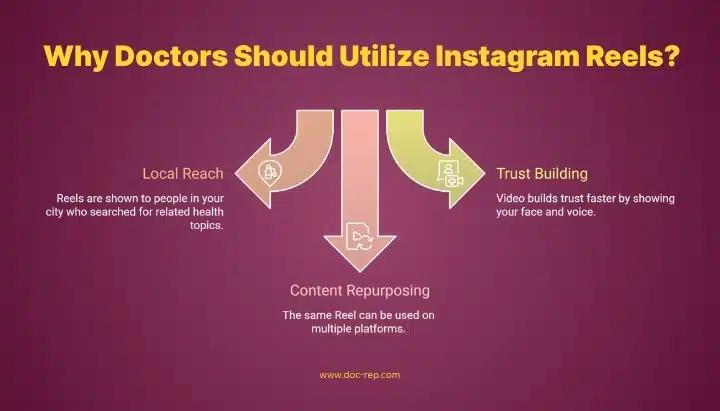
Three things happen when a doctor posts a Reel that a regular feed post cannot match.
First, the algorithm shows it to people in your city who searched for related health topics. A dentist in Tampa who posts about wisdom tooth pain can land in front of someone two zip codes away who Googled it that morning.
Second, video builds trust faster than text. Patients see your face, hear your voice, and decide if they like you before they ever call.
Third, the same Reel can be repurposed across TikTok, YouTube Shorts, and Facebook Reels, so one filming session feeds four platforms.
What Makes an Instagram Reel Actually Work?
A Reel works when it hooks the viewer in three seconds, delivers one clear point, and ends with a next step. Most doctors fail on the first part because they open with their credentials or a slow intro.
The 3-second hook is the line or visual that stops the scroll. It should name the symptom, the myth, or the question on screen and out loud. “Why does your jaw click when you chew?” works. “Hi, I’m Dr. Smith, board-certified in oral surgery” does not.
One Reel should answer one question. If you cover three myths in a 30-second video, viewers remember none of them. Pick one. Save the others for next week’s post.
We tested two versions of the same Reel for a TMS clinic. One opened with, “What is TMS therapy?” The other began with, “Does insurance cover TMS therapy? Here’s what most patients qualify for.” The second Reel increased profile visits by 18% and generated 23 more saves. The medical information stayed exactly the same. The only difference was the opening line. It reinforced a simple lesson: patients engage with content that answers the questions they’re already asking.
Voiceover, on-camera, and text-only formats each serve a purpose. On-camera is best when you want patients to recognize you. Voiceover works when you want to show B-roll of the clinic, equipment, or hands at work. Text-only is fine for quick myth-busts but should not be your default, because trust comes from a face.
Captions on screen matter because many people watch Reels without sound. Add burned-in subtitles instead of relying only on Instagram’s auto-caption sticker so your message stays clear even when audio is muted.
Lighting and audio are the easy wins. Film by a window during the day. Use a $20 lavalier mic plugged into your phone. Both fixes take fifteen minutes and lift production quality more than any filter.
How Long Should a Doctor’s Instagram Reel Be?
The best length for a doctor’s Reel is 30 to 45 seconds for educational content, 30 seconds for quick myth-busts or hooks, and 60 to 90 seconds for storytelling or full procedure explainers. Instagram now allows Reels up to 3 minutes when recorded in the app, but Adam Mosseri (head of Instagram) has said Reels over 90 seconds tend to get less reach.
The lesson for doctors: short and clear beats long and thorough almost every time. Save the long-form videos for a YouTube video or a blog post and link from the Reel.
5 Instagram Reels Ideas for Doctors and Healthcare Professionals
Below are 5 Instagram Reel ideas doctors & healthcare professionals can use to share useful information and connect with more patients online.
1. Myth-Busting Reels: Debunk a Common Health Myth in 30 Seconds
Myth-busting Reels work because patients love feeling smarter than the internet. You name a belief they have heard, then explain what is actually true. The pattern triggers shares, because viewers want their friends to know too.
Pick myths your patients actually bring up. Listen at the front desk for a week and write down every “I heard that…” statement. Those are your scripts.
Script template: “You’ve probably heard [myth]. Here’s what’s actually true.”
Myth-busts travel further than straight education because they have a built-in conflict, which the algorithm reads as engagement.
2. Symptoms You Should Never Ignore
This format pulls in viewers who are actively worried about a symptom right now, which is the highest-intent traffic on the platform. You name three symptoms, explain why they matter, and tell people what to do next.
Pick symptoms tied to your specialty. A cardiologist talks about chest pain that spreads to the left arm, sudden shortness of breath, or pain that wakes you at night. A neurologist covers sudden severe headache, vision loss in one eye, or a numb arm. A dentist mentions tooth pain that throbs when you lie down, swelling on one side of the face, or a tooth that feels loose.
Script template: “If your [symptom] does [specific thing], don’t wait. Here is why.”
The line between informing and scaring is real. Stay on the right side by being specific about what to do, not vague about what could go wrong. “Call your dentist this week” is good. “You could lose your tooth” without context is fear-mongering.
Always end with the next step. “Book an appointment,” “Call your primary care doctor,” or “Go to the ER if it gets worse” gives the viewer a clear path. Without that line, viewers scroll on.
Real example: A Charlotte ophthalmologist posts a Reel titled “3 vision changes that mean call us today.” She lists sudden floaters, a curtain over part of your vision, and flashes of light. The Reel has driven over 40 phone bookings in six months, tracked by her front desk asking how each new patient heard of her.
3. Patient FAQ Reels: Answer the Questions You Get Asked Every Day
FAQ Reels solve a problem you already have: the same five questions you answer over the phone every week. Film each answer once, post it as a Reel, and the video keeps working while you sleep.
Mining content ideas is simple. Ask your front desk to track the top ten questions for two weeks. Ask your medical assistants what patients always ask at intake. Those lists become your next twenty Reels.
Turn each question into a 20- to 30-second answer. “How long does this procedure take?” “Will my insurance cover it?” “Do I need to fast before this test?” These are real questions real patients are typing into Instagram search right now.
Specialty examples that perform well:
- “Does Botox hurt?” (aesthetics)
- “How does TMS therapy actually work?” (psychiatry)
- “How long does laser hair removal really last?” (dermatology)
- “Can I work out the day of my chiropractic adjustment?” (chiropractic)
Stack FAQ Reels into a series with the same opening graphic and a numbered title. “Patient Question #1,” “#2,” and so on. Viewers who like one will tap your profile to find the rest, which lifts profile visits, a strong ranking signal in the 2026 algorithm.
4. Procedure Walkthroughs and Treatment Explainers
A procedure walkthrough shows the process without showing any patient. You film the room, the equipment, the prep tray, your hands, and use voiceover to explain what happens step by step. Patients fear what they do not understand, and this format removes that fear before they book.
B-roll ideas that are always safe: the chair from behind, instruments laid out on a clean tray, your gloved hands on a model, the monitor with no patient data visible, the room being cleaned, your headlamp turning on.
Explain the procedure in plain English. Not “we administer 4mg of midazolam IV.” Try “we give you something to help you relax through your IV.” Grade 8 reading level is the goal. If your aunt would not understand the sentence, rewrite it.
To discuss a real case, keep it general. “Last week I saw a patient with a really common issue, here’s what we did” is fine. “Last Tuesday I treated a 34-year-old woman from Maple Street” is a HIPAA violation, because that combination of details could identify her.
Real example: A vascular surgeon in Dallas films a 60-second walkthrough of a varicose vein procedure using only B-roll of his tools and the ultrasound machine. He voices the steps while showing the equipment. The Reel has 280,000 views and led to a measurable jump in consult requests from his website’s contact form.
5. Meet the Team and Staff Spotlight Reels
Team Reels work because patients book the person, not the practice name. Quick intros, one staff member at a time, give every team member a face on your feed.
A simple format: name on screen, role, one fun fact, one thing they want patients to know. Fifteen seconds, one staff member per Reel. Film six in one afternoon, post one per week for six weeks.
Feature the nurses, medical assistants, hygienists, and front desk team, not just the doctor. Patients spend more total minutes with the staff than with you. When the front desk person they call has already smiled on a Reel, the call feels warmer.
Real example: A family medicine practice in Portland filmed thirty-second Reels of each team member. The receptionist’s Reel got more views than any of the doctors’ posts, because patients recognized her voice from booking calls. The practice now films one staff Reel a month and reports new patients mentioning specific team members by name on intake forms.
HIPAA and Compliance: What You Can and Can’t Show in a Reel
HIPAA rules apply to every Reel that mentions, shows, or implies a patient. The Office for Civil Rights treats Instagram the same as any other channel where protected health information can leak.
The PHI checklist before you hit Share:
- No patient is in the frame, including in mirrors, reflections, or backgrounds.
- No charts, screens, schedule boards, name tags, or whiteboards are visible.
- No patient is named in the caption, comments, or audio.
- No procedure is tied to a specific date that could identify when a known patient was treated.
- Any patient you do feature has signed a written authorization that names Instagram by name.
Comment moderation is where many violations actually happen. A patient may reply on your Reel saying “I had this done last week, it was amazing.” Even your “like” on that comment can confirm a treatment relationship, which is a disclosure. The safer move is to delete the comment or reply privately by DM, never confirming care publicly.
Direct messages count as electronic PHI under HIPAA. Standard Instagram DMs are not HIPAA-compliant. If a patient asks a medical question by DM, respond with “please call our office,” not with medical advice.
Disclaimers belong in captions when content could be read as medical advice. A simple line like “This is educational content, not medical advice. Talk to your doctor about your situation” goes at the end of any symptom or treatment post.
Are Instagram Reels HIPAA Compliant?
Instagram Reels are not inherently HIPAA-compliant or non-compliant. The platform is just the channel. Whether your Reel is compliant depends on whether you have shared protected health information without written authorization.
A Reel with no patient, no chart, no identifying detail, and only general education is fine. A Reel that features a named patient, an identifiable face, or a specific case story without signed authorization is a violation, even if you only have ten followers.
The most common compliance mistakes doctors make on Instagram:
- Replying to patient comments that confirm treatment.
- Filming in the clinic without clearing the background of paperwork and screens.
- Using general consent forms that don’t name social media as a use.
- Posting before-and-afters based on verbal consent only.
- Tagging a patient who tagged the practice first, which confirms the treatment relationship.
HIPAA penalties run from $137 to over $68,000 per violation as of the 2024 inflation adjustment, with annual caps over $2 million per violation category, according to the HHS Office for Civil Rights.
Instagram Reels Ideas by Medical Specialty
The seven formats above adapt to almost any specialty. Here is a quick reference for ten common practice types.
Instagram Reels Ideas for Psychologists
Myth-bust the difference between therapy and counseling. Walk through what a first session actually looks like. Answer “how do I know if I need therapy?” Address the cost question directly. Keep faces of clients out of every frame.
Instagram Reels Ideas for Physiotherapists
Show one stretch per Reel with form cues on screen. Bust the “no pain, no gain” myth. Demonstrate post-surgery recovery exercises on yourself, not on a patient. Walk through what a first assessment looks like.
Instagram Reels Ideas for Therapists
Explain one CBT or DBT skill in 30 seconds. Answer “how is therapy different from talking to a friend?” Address the stigma question. Show the empty office and your seat, never a client’s chair with anything that could identify them.
Instagram Reels Ideas for Psychiatrists
Explain how medication actually works in plain English. Address common fears about starting antidepressants. Bust myths about psychiatric care versus therapy. Show the waiting room and your prescription pad workflow, never a real script.
Instagram Reels Ideas for Mental Health Clinics
Spotlight each clinician with a short intro Reel. Walk through the intake process step by step. Cover insurance questions patients ask before they call. Show the building exterior and lobby, never any client.
Instagram Reels Ideas for Dermatologists
Bust common skincare myths, walk through Mohs surgery using B-roll of instruments and procedural visuals, explain the difference between cosmetic and medical dermatology visits including costs and insurance coverage, and share seasonal skincare tips for summer, winter, spring, and fall.
Instagram Reels Ideas for Chiropractors
Show one mobility test per Reel. Bust the “cracking is bad for you” myth. Explain the difference between adjustments and massage. Address insurance and how many visits a typical plan covers.
Instagram Reels Ideas for Ophthalmologists
List symptoms that mean see an eye doctor today. Bust myths about screen time and vision. Walk through what a comprehensive exam includes. Demonstrate the autorefractor and other equipment.
Instagram Reels Ideas for Cardiologists
List heart attack symptoms women experience differently than men. Bust the “if you exercise you can’t have heart disease” myth. Walk through what an EKG measures. Answer “when should I see a cardiologist?”
Instagram Reels Ideas for TMS Clinics
Walk through what a TMS session feels like. Bust the “TMS is shock therapy” myth, which is the single most common misconception. Show the chair and the coil, no patient in frame. Cover insurance coverage and session count.
How to Plan and Batch Reels Without Burning Out
Filming one Reel at a time burns most doctors out by week three. Batch filming solves it. Block 90 minutes once a month, change shirts twice, and film six to eight Reels in one session.
A monthly calendar built around the seven formats might look like this:
- Week 1: One myth-bust, one FAQ
- Week 2: One symptom Reel, one procedure walkthrough
- Week 3: One team spotlight, one day-in-the-life
- Week 4: One before-and-after (if you have signed consent), one repeat of whatever did best
That gives you eight Reels a month, posted twice a week. Reels need consistency more than volume. TrueFuture Media’s 2026 analysis recommends three to four Reels per week for businesses focused on growth.
Repurpose each Reel into Stories the day after it posts, then into TikTok and YouTube Shorts the same week. Tools clinicians actually use:
- CapCut: free, mobile, easy captions
- InShot: similar, slightly simpler interface
- Later: scheduling and analytics
- Metricool: scheduling with healthcare-friendly approval workflows
Avoid AI voice generators or deepfake tools for medical content. Patients catch it, and the FTC has started enforcement actions against synthetic medical endorsements.
How to Measure if Your Reels Are Actually Working
The metrics that matter for a medical practice are saves, shares, profile visits, website link taps, and DMs. Likes and follower count look nice but do not bring in patients.
Saves tell you the content was useful enough that someone wants to find it again. Shares tell you it was useful enough to send to a friend. Both signal high quality to the algorithm and lead to more reach.
Profile visits are the bridge between a Reel and a booking. If 500 people watched but only 5 visited your profile, the Reel was entertaining but did not earn trust. If 50 of 500 visited, your content is converting attention into interest.
Website taps and DM volume are the closest things to a booking metric inside Instagram. Track them weekly. If a Reel drove 20 website taps and you usually get 5 a day, you found a winning format. Make three more like it.
Tie performance back to consultations. Train your front desk to ask “how did you hear about us?” on every new patient intake and log Instagram separately. After two months, you will know which Reels actually filled the schedule, not which ones got views.
When to repost: a Reel that performed well three months ago can be reposted with a fresh caption. Instagram does not penalize this, and new followers will not have seen it. When to retire: if a format gets low saves and shares for three posts in a row, drop it.
Common Mistakes Doctors Make With Instagram Reels
The same five mistakes show up across every specialty. Each one is easy to fix once you see it.
- Clinical jargon kills engagement: A cardiologist who says “myocardial infarction” loses viewers in two seconds. “Heart attack” keeps them. Write every script at a Grade 8 reading level, the same level newspapers aim for.
- Bad lighting and wrong orientation: Vertical 9:16 is the only format Instagram pushes for Reels. Filming horizontally forces a crop that looks amateur. Stand by a window between 10 a.m. and 2 p.m. for the best free lighting in any room.
- No on-screen captions: Most viewers watch with the sound off. If your video has no burned-in subtitles, you lose them. Use CapCut’s auto-caption feature, then read through and fix the medical terms it misspelled.
- Inconsistent posting: The algorithm rewards regular activity. Two Reels a week beats six Reels one week and nothing for a month. Pick a schedule you can hold for six months.
- Trying to go viral instead of converting: A Reel with 2 million views from random viewers in other countries does nothing for your practice. A Reel with 4,000 views, all in your city, that drives 12 phone calls is worth ten times more. Build for your local patient, not for the global algorithm.
Final Words
Reels are the fastest way for a doctor to reach new patients in 2026, but only if you treat them like patient care: clear, accurate, and respectful of privacy. Pick two formats from the seven above and commit to them for sixty days. Track which one drove more profile visits and website taps. Then add a third.
Most practices that fail at Instagram fail because they post once, get few views, and quit. The practices that win post twice a week for six months, batch their filming, and stay tight on HIPAA from day one.
If creating Reels, planning content, editing videos, and staying consistent feels overwhelming, Doc-Rep can help. As part of our Social Media Marketing Services for Doctors, Doc-Rep helps practices create engaging Instagram content, grow their audience, and attract more patients while staying HIPAA-aware.

Atiur Rahman
Medical & Healthcare SEO Expert focused on turning search visibility into booked patients and revenue. Specialties: technical SEO, schema and LLM visibility, AI SEO/GEO, and local search for clinics.