Traditional SEO and Generative Engine Optimization (GEO) are two digital patient-acquisition strategies that help medical practices build visibility across both traditional search and AI-powered answer engines.
For years, patient acquisition through organic search was straightforward: rank on Google, earn the click, and convert that visitor into a patient.
That search journey is changing. Patients can now turn to platforms such as ChatGPT, Gemini, and Perplexity for answers, recommendations, and information about healthcare providers before they ever visit Google.
That creates two distinct but connected opportunities for medical practices. Traditional SEO focuses on Google rankings, local search visibility, Google Business Profile performance, website traffic, and appointment conversions. GEO focuses on making practice’s content, expertise, and information easier for AI systems to understand, retrieve, cite, and potentially surface in generated answers.
Consider a patient searching for mental health care. Instead of typing a series of keywords into Google, they might ask an AI platform, “Who is an experienced, highly rated therapist near me who treats adult ADHD?” The way that question is answered depends on more than traditional keyword rankings. The practice also needs clear, authoritative, and well-structured information that AI systems can interpret and use.
Healthcare makes this shift particularly important. Medical content falls within Google’s Your Money or Your Life (YMYL) category, where accuracy, expertise, and trustworthiness carry significant weight. AI-generated healthcare answers also create a higher bar for reliable information because inaccurate recommendations can directly affect patient decisions.
So, does traditional SEO still deliver a return on investment as patient search behavior evolves? What does GEO actually require from a clinical website? And how can practices adapt without compromising their reputation or relying on unproven AI optimization tactics?
The short answer: Traditional SEO isn’t dying. It just no longer works in isolation.
What Is Generative Engine Optimization (GEO)?
Generative Engine Optimization (GEO) is the practice of structuring and authoritative formatting of your digital content so that AI-powered engines can easily process, trust, and quote your practice as an expert source in their direct answers.
In practical terms, GEO ensures that when a patient asks an AI tool a complex health question, the model extracts your clinical insights and attributes your practice as a recommended authority.
What Does Traditional SEO Still Do For Your Practice?
While more patients are leaning on AI to research symptoms, conditions, and treatment options, organic local search remains the primary engine driving actual appointment conversions.
Traditional SEO still dictates whether your practice shows up in Google’s local map pack, localized organic results, and your Google Business Profile (GBP). These are the exact digital channels prospective patients visit when they are ready to select a provider and make a phone call or submit an intake form. GEO operates alongside these conversion pathways rather than replacing them.
The core mechanics of local search remain vital:
- Targeted Keyword Optimization: Ensuring service pages align with high-intent search queries.
- Technical Health: Maintaining a fast, mobile-friendly, and accessible site architecture.
- Authority Signals: Building a clean backlink profile from reputable healthcare and regional organizations.
- Local Listings & Reputation: Managing an accurate Google Business Profile with verified patient reviews and consistent Name, Address, and Phone (NAP) details across the web.
The Local AI Realignment
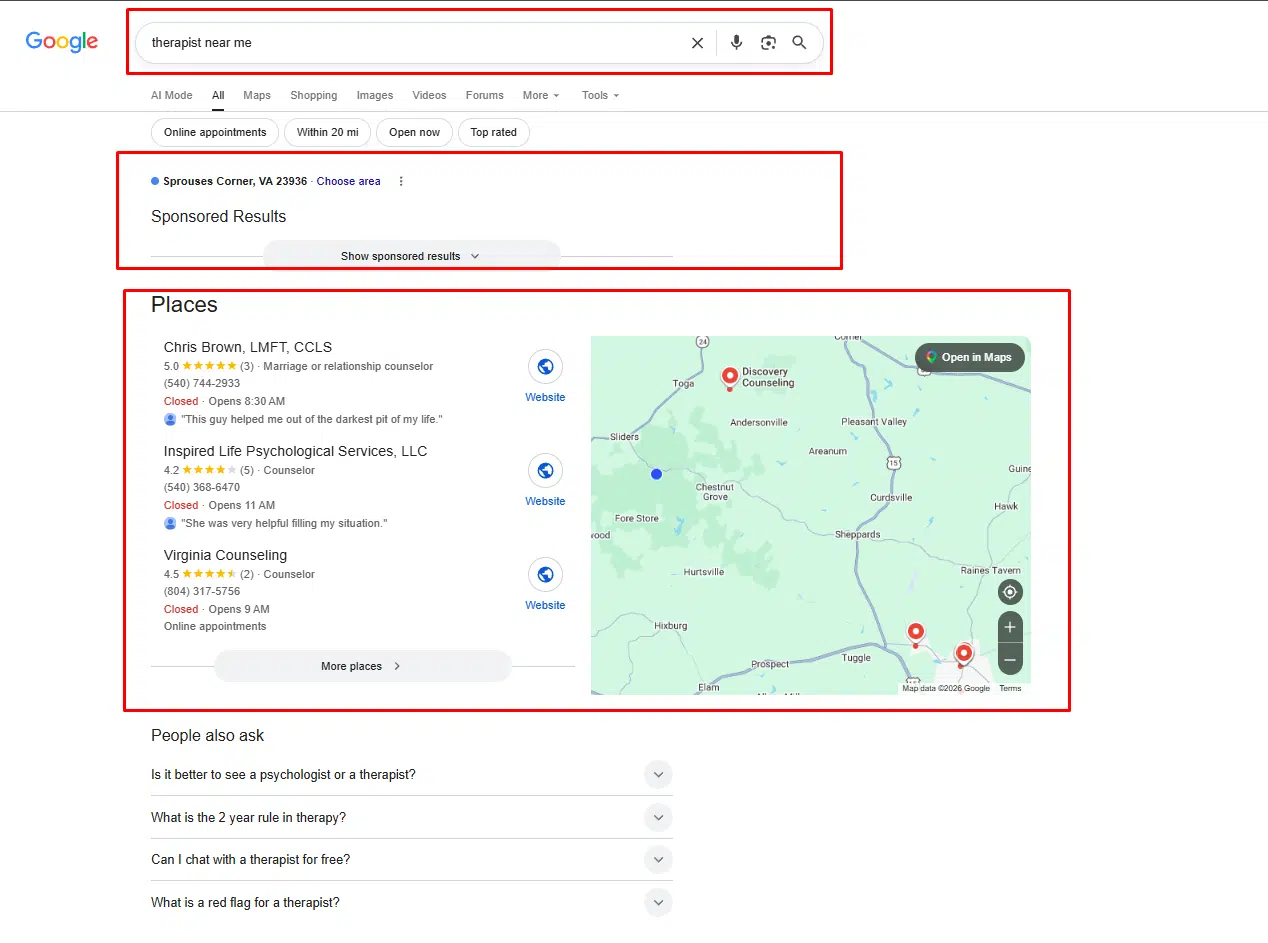
It is also worth noting how search engines handle immediate local intent. When Google tested AI summaries on localized, high-intent searches (like “therapist near me” or “TMS clinic near me“), they quickly pulled back.
It became clear that when patients need a real-world provider, they want a direct map pack, clear office hours, and verified patient reviews, not a synthesized paragraph of text. Consequently, foundational local SEO remains your strongest asset for capturing immediate booking intent.


SEO vs. GEO: Key Differences
Where traditional SEO focuses on driving clicks to your site through high rankings on search engine results pages, GEO focuses on how language models gather, aggregate, and cite information within synthesized answers.
Industry discussions often throw around related terms like Answer Engine Optimization (AEO) or Large Language Model Optimization (LLMO). These all refer to the same fundamental shift, which major search platforms treat as an organic evolution of search rather than a separate discipline.
| Focus Area | Traditional SEO | GEO |
| Primary Goal | Secure top rank positions and drive website traffic | Earn direct citations and brand mentions inside AI answers |
| Key signals | Page speed, keyword placement, backlinks, review counts | Peer-reviewed citations, concrete stats, schema, clinical E-E-A-T |
| Where you win | Organic blue links, Google Local Map Pack | ChatGPT, Perplexity, Gemini, Google AI Overviews |
| How you measure it | Search rankings, organic traffic, click-through rates | Share of AI voice, brand citations, direct mentions |
| Example query | “Therapist Austin TX“ | “What causes adult acne and what treatments work best?” |
Why Modern Search Shifts Hit Medical Practices Harder?
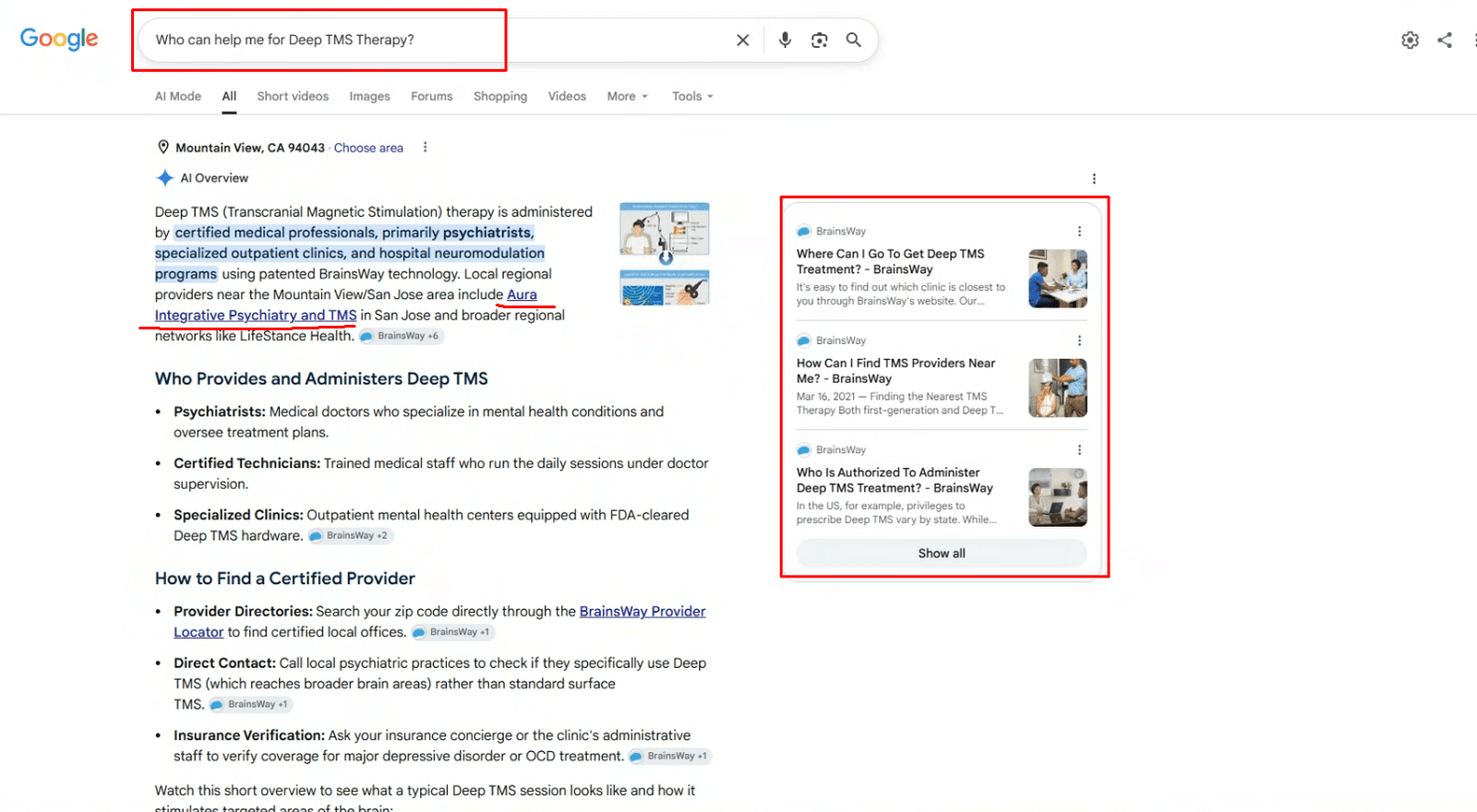
Health-related searches, from symptom checks to specialized treatment options, trigger AI summaries at a far higher rate than most other consumer queries. Compounding this is a broader behavioral shift: zero-click searches.
Across the web, over two-thirds of searches now end without the user ever clicking through to an external website. When an AI summary appears at the top of a search result, traffic to traditional organic links drops dramatically. Tens of millions of people now turn directly to AI platforms every day to ask health-related questions, treating conversational assistants as a first stop for medical advice.
Search algorithms and language models scrutinize medical content severely because improper medical advice carries real health risks. A casual blog post about interior design isn’t vetted with much rigor; a page detailing drug interactions or psychiatric treatments is evaluated under strict clinical quality standards before any engine will cite it.
How Do AI Engines Decide What To Cite?
AI models lean on established digital trust frameworks while weighing specific content markers that prove clinical authority.
1. Clinical E-E-A-T
E-E-A-T (Experience, Expertise, Authoritativeness, and Trustworthiness) is the foundation of modern medical content evaluation. To earn trust from both search algorithms and language models:
- Every clinical article should display a named, credentialed medical professional (e.g., a board-certified physician or licensed provider) rather than an anonymous “Marketing Team.”
- Pages must include visible “Last Clinically Reviewed On” dates alongside reviewer credentials.
- Content should reference established medical research, academic journals, or institutional health databases.
2. Core GEO Content Elements
In-depth testing on generative search mechanics shows that AI engines favor specific content structures over traditional keyword optimization:
- In-Text Research Attribution: Directly referencing recognized clinical literature, medical boards, and peer-reviewed journals within the narrative.
- Direct Expert Commentary: Including quotes and insights attributed to credentialed clinical directors and physicians.
- Hard Data Points: Integrating concrete statistical figures accompanied by clear source context.
While classic SEO relies heavily on keyword placement, language models care far more about whether a page offers clear, well-supported, and verifiable facts.
3. Schema Markup
Schema markup is machine-readable code applied to your website that explicitly defines content for search crawlers and AI bots. Implementing schema types like MedicalWebPage, Physician, MedicalCondition, and FAQPage gives AI models an unambiguous data structure to verify your services, credentials, and practice details. It eliminates technical guesswork, ensuring language models interpret your clinical data accurately.
Schema won’t force an AI tool to cite you. But it does remove the guesswork that could get you passed over.
Will GEO Replace SEO for Doctors?
No, GEO will not replace SEO for doctors. SEO is the foundation of GEO. Search engine optimization helps doctors build the website authority, topical relevance, content quality, and technical foundation that AI platforms can use when generating answers.
GEO adds another layer by optimizing that content for AI visibility and citation. Instead of replacing SEO, GEO works alongside it, helping independent practices compete for visibility in AI-generated answers, even against larger healthcare organizations with significantly bigger marketing budgets.
Traditional SEO still heavily favors established sites with strong domain authority and extensive backlink profiles. GEO creates another opportunity. Language models can evaluate factors such as content clarity, extractability, authority, and supporting citations.
A well-structured, physician-authored page from an independent practice can therefore become a useful source for an AI answer, even when it does not outrank a major health system in traditional search.
For doctors and small practices, the advantage is clear: SEO builds the foundation, while GEO expands where that visibility can appear.
Is Local SEO Still Worth The Investment For Medical Practices?
Yes, and increasingly for a new reason.
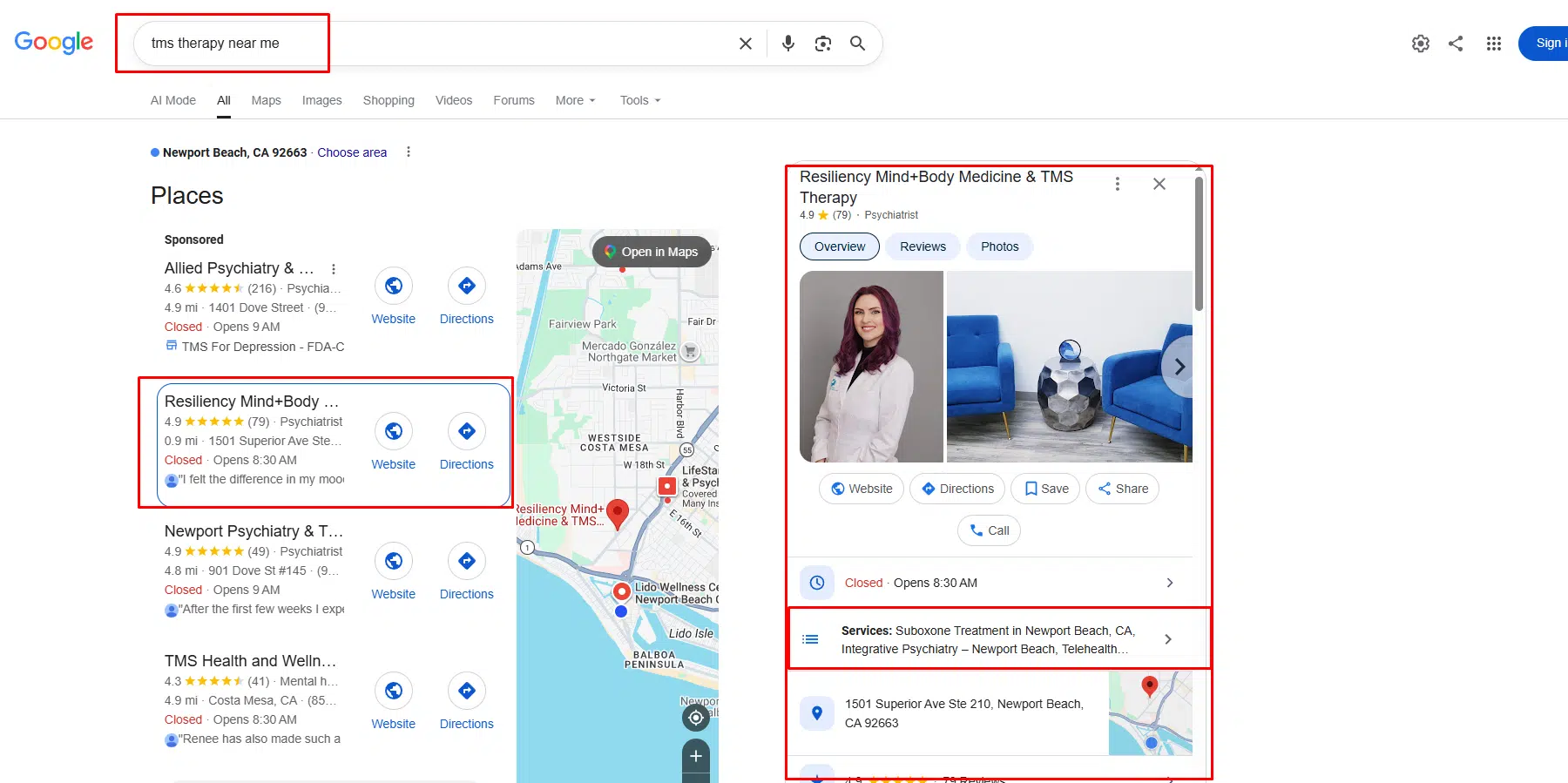
Local SEO is no longer just about ranking in map packs. It serves as the ground-truth database that AI models query to verify real-world businesses.
Your Google Business Profile functions as your primary entity record online. When a patient asks an AI model for provider recommendations, the platform cross-checks web data against your core profile to verify operating hours, phone numbers, addresses, and offered services.
Profile inaccuracies carry immediate financial consequences. Nearly half of all patients now use AI tools when researching healthcare providers, and roughly two-thirds of those patients report encountering flat-out wrong information, such as disconnected phone numbers, wrong office locations, or incorrect operating hours. A stale local listing doesn’t just cost you a map ranking; it causes AI models to distribute inaccurate contact details, silently bleeding prospective patient conversions.
What Should You Actually Do?
In every audit I run, step one is the same. Protect what already works. Then layer AI-specific tactics on top, instead of tearing up your existing SEO plan. Here’s a practical order of operations.
- Keep local SEO fundamentals intact. Google Business Profile accuracy, review volume, and consistent NAP data still drive the most bookings, and none of that work goes to waste.
- Audit E-E-A-T signals on every clinical page. Add a named physician author, visible credentials, and a last-reviewed date to anything covering symptoms, conditions, or treatments.
- Add structured data. Set up MedicalWebPage, Physician, MedicalCondition, and FAQPage schema so AI tools can confirm facts about your practice without guessing.
- Write for extraction, not just ranking. Put a direct, quotable answer near the top of each page. Back it with a named statistic and its source. Use clear, question-based subheadings.
- Track AI citations, not just rankings. A newer group of tools now tracks brand mentions across ChatGPT, Perplexity, and AI Overviews. Rank tracking alone no longer shows the full picture.
Don’t skip content depth to chase GEO tactics, though. The Princeton research tested these methods on top of solid content, not as a replacement for it. A thin page with three statistics bolted on will not beat a genuinely thorough one.
What’s The Biggest Mistake Practices Make With GEO?
The most common mistake I see is abandoning SEO for AI Hype.
Pulling marketing budget away from local map optimizations to chase AI citations often destroys the primary channel driving your immediate phone calls and appointments.
A second version of this mistake shows up inside the content itself. Simply pasting unverified statistics into blog posts without medical backing or credentialed physician oversight will fail E-E-A-T standards. Language models value contextual expertise over superficial optimization.
A third mistake is ignoring accuracy risk while chasing visibility. Never assume AI engines describe your practice accurately. Regularly query major AI models to ensure your clinic’s services, providers, and locations are represented correctly.
Final Thoughts
Digital patient acquisition is no longer a choice between traditional SEO and GEO. It is an integrated ecosystem where prospective patients move fluidly between standard search engines and conversational AI platforms.
While healthcare practices face heightened scrutiny under YMYL standards, those same standards create an incredible competitive opportunity. By combining disciplined local search fundamentals with physician-authored, well-structured, and authoritative clinical content, your practice can stand out as a trusted choice across every platform patients use to find care.

Atiur Rahman
Medical & Healthcare SEO Expert focused on turning search visibility into booked patients and revenue. Specialties: technical SEO, schema and LLM visibility, AI SEO/GEO, and local search for clinics.