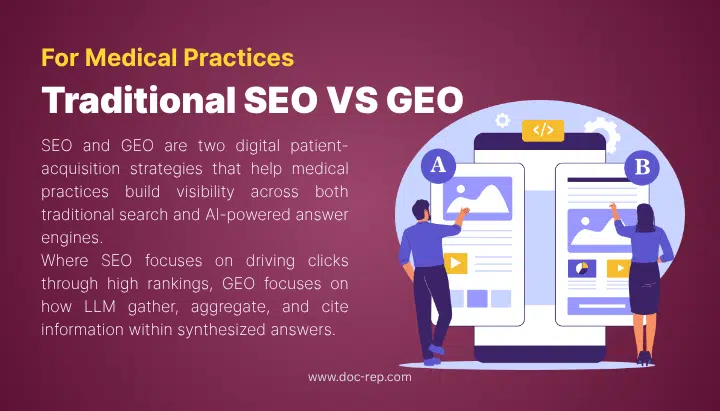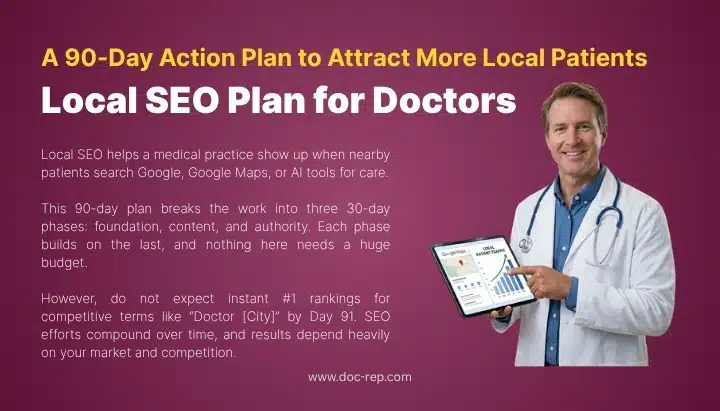
Small clinic SEO refers to the methods used to optimize an online presence for a medical practice so it apeears in local search for healthcare in Google Search, Google Maps, and other places.
For small clinics, effective SEO combines local SEO, technical SEO, optimized service and physician profile pages, Google Business Profile optimization, patient reviews, quality medical content, and a website designed to encourage appointment bookings.
Patients uses search engines to examine and compare healthcare providers, check and analyze symptoms and available and appropriate treatments, and also view testimonials and reviews before deciding to book an appointment.
Building an optimized Google Ads campaign and the ads themselves pulls in a good volume of traffic and potential patients in a short time, but stops the moment the ads budgets are exhausted.
Organic SEO for small clinics, on the other hand, builds a practice’s ranking in search engines, and pulls in a volume of potential patients via practice’s website for an extended time.
The content on a small practice’s website plays a major role in attracting patients by building trust and authority, which helps improve local search rankings.
This guide focuses on 13 SEO tips & best practices for small clinics, from an investment standpoint. The focus is on improving search rank on Google, boosting free traffic, and increasing patient bookings.
1. Create a Modern, Mobile First & Fast website
Every SEO strategy needs a base, and that base is a modern, fast, mobile-friendly website. None of the following tips can be optimized without one. Traffic has no meaning if your website fails to convert visitors into booked visits. A website from a decade ago with tiny text and broken menus can leave patients thinking your practice is behind in other areas.
There are three considerations. Web pages need to load in under three seconds. Every page needs to be easy to read on mobile devices. Finally, there has to be an easy way to book a visit on every page. Google rewards web pages that meet these requirements, and so do your patients.
2. Create / Optimize Your Google Business Profile
First, claim and verify your Google Business Profile. You need to ensure that no fields are left blank, as a complete profile gets your listing on Google Maps. Most searches for nearby care happen on Google. A small Clinic does not need to rank for services that are a hundred miles away. It’s a win to rank for a 15-mile radius.
This one tactic works best. List all services on the Google Business Profile, then link the services to the services page on the website. This brings patients to the related service page and helps Google confirm the services that the clinic offers. It’s important to keep information in the profile, such as phone numbers and photos, up to date. Also, you should ask for reviews after each appointment.
3. Create Dedicated Service Pages
You should create a dedicated service page for each medical service. You won’t be able to rank an “Our Services” page if you have multiple treatments. A dedicated page helps you answer patient questions. Additionally, you can rank for the search terms that patients are typing.
Each service page should include the definition of the service, the target population, the patient journey, the insurance details, and the appointment process.
The patient is the primary audience for this information; write in plain language and introduce clinical terms only when necessary. A service page that is dense with clinical language is unlikely to be read and will inhibit the user from booking.
4. Create & Optimize Your Service Page Hub
All individual service pages should be directly linked from a central service page, for example, yoursite.com/services, with individual pages at /services/service-name. A service page hub simplifies navigation for your patients. This also aids the search engines with the interrelatedness of the service pages.
Your service page hub should include templates for service offerings to help your practice scale and diversify without the need for redundant page builds.
5. Build Location Specific Service Pages
Every location service page should be unique. Every service page should contain the service offerings at that location, the service staff, business hours, contact information, and pertinent locational information. Simply changing the city name is a near duplicate page to Google and can be treated as a doorway page.
A practice that serves three locations has one contact page with three addresses. The contact pages should be fully separate from the services and staff pertinent to that location. This would allow the practice to be competitive in three local service areas.
6. Create Physician Profile Pages
When choosing a healthcare provider, patients select an individual physician rather than a collective group. To that end, individual pages containing details about each physician’s background, board certification, areas of specialty, duration of practice, the conditions they manage, and their location of practice are needed. To further engage prospective patients, each page should contain a practice promo video or a video statement.
Each page should also contain a mechanism for prospective patients to schedule an appointment. Visitors to a physician’s individual page are likely to be making an appointment, so the opportunity to schedule an appointment should not be missed. Each page is likely to rank in search results as the physician’s popularity increases.
7. Organize Content by Condition and Treatment
Divide the medical content on your website into pages that correlate conditions and available treatment options. In doing so, ensure that you offer a conditions page that explains the conditions and answers the frequently asked questions regarding treatment and what to expect during and after the treatment. Create a parallel page that addresses the treatment options of the condition in addition to the available options for the level of care, and what to expect during and after the treatment.
This is the most likely approach to reach patients in varying stages of information and treatment. An individual researching treatment for “plantar fasciitis” is likely at a different stage than the individual searching for “shockwave therapy” in proximity to them. Each approach will likely drive the first to the latter.
8. Link Connected Pages
Every relevant page should be connected through internal links. Conditional pages should link to the related treatment options, the doctors, and the associated locations. Each of these pages should include the corresponding links.
This method allows patients to find related services and allows Google to identify the specific areas of expertise the clinic provides. Internal links are also useful for transferring ranking strength from established pages to newer pages, especially since these pages need the links more.
9. Publish Symptom-focused Content
Every search starts with how a patient feels and not how the doctor bills the service. For example, someone would say they have “sharp heel pain in the morning,” not that they are in need of “plantar fasciitis treatment options.” Having web pages designed around specific patient symptoms will help you attract patients at an earlier stage in their journey, quite often before competitors do, for example, in the instance of the patient with plantar fasciitis.
Pages centered on specific symptoms help you achieve a high conversion rate. For example, a patient who is in a significant amount of pain is highly likely to respond to the text “We treat this symptom; here is how” with a higher level of engagement. Having service pages is also very important, as some patients will search by service name. Hence, it is important to also add the service name.
10. Improve E-E-A-T With Physician Involvement
Google evaluates health content against E-E-A-T metrics, focusing on Experience, Expertise, Authoritativeness, and Trustworthiness. Topics in health content are among the most scrutinized segments of content, called ‘your money or your life’ content. Small clinics, especially, have an advantage in this area: they have real doctors.
Leverage that advantage in your health content. Have each article reviewed by a physician, and list them as the reviewers. Include a physician’s statement in each article and cite their profile. For each clinical claim, cite a reputable medical source. All these tactics help build trust with your users and help Google understand who is supporting the claims in your content.
11. Make Appointment Booking Easy
Give patients several ways to book an appointment. This includes a click-to-call button, a listed phone number, an online booking option, and a contact form. There is a direct correlation between the age of a patient and their preferred method of scheduling.
Patients who are older prefer to book via a call and may prefer a visible phone number, while younger patients may prefer to book via the website. If you want to avoid losing a patient, make sure an option to book is available on every page. The accessibility and ease of booking an appointment are as important as a clinic’s reputation.
12. Maintain the Accuracy of Your Website’s Medical Content
Every clinical claim must be accurate. Every clinical claim or piece of medical content published on your website needs to be given approval by a qualified healthcare professional before it goes live. Publishing inaccurate medical content not only puts your clinic at legal risk but also puts your patients at risk.
Avoid making promises regarding expected outcomes and refrain from making “best in the area” statements. First, they invite scrutiny from regulators. Second, they communicate nothing to patients. You are encouraged to plainly state the services your clinic offers. Conversely, you are discouraged from making empty statements. Finally, for anything that may be perceived as clinical, get a legal review before you publish.
13. Maintain HIPAA Compliance
SEO in healthcare has additional layers beyond traditional SEO practices. Patient privacy must be a key concern in healthcare marketing. Specific legislation, including the Health Insurance Portability and Accountability Act (HIPAA), and the General Data Protection Regulation (GDPR) may be relevant considering where your clinic operates. Regardless, every healthcare practice should protect patient data.
Don’t use marketing or analytics tools that collect protected health information unless those tools help you maintain your compliance. Don’t post patient stories, testimonials, or photographs unless you have the patients’ consent in writing. When responding to online reviews, you should never confirm that the reviewer is (or was) a patient, even if they include private, protected healthcare information in the review. If you follow those guidelines, you will maintain patient privacy, lower your compliance and legal risks, and gain the trust of your patient base and search engines.
How Doc-Rep Helps Small Clinics Grow Through SEO
Doc-Rep offers small medical practices and clinics cost-effective Medical SEO services starting at $499 a month with no long-term contracts. The Doc-Rep team takes care of technical SEO, service pages, location pages, physician profiles, Google Business Profile optimization, and HIPAA compliant content. This allows small clinics to gain more visibility on Google and get more patients through organic search. SEO is a great alternative for clinics who cannot afford a large marketing budget to contact patients through paid ads
Final Words
SEO provides small clinics with something paid ads can’t: a patient pipeline that continues after the spending stops. The process is simple. Revamp the website. Create or claim the Google Business Profile. Construct and interlink pages for each service, location, doctor, condition, and symptom. Ensure that all medical claims are compliant and correct. For a practice with a single location, this work typically takes three to six months. Moreover, once properly implemented, it is the most economical patient acquisition channel for the practice.

Imamul Muttakin
Imamul Muttakin is a healthcare digital marketing & SEO strategist specializing in B2B growth for medical billing companies and B2C patient acquisition for medical practices. He builds data-driven, compliance-focused marketing systems that turn clicks into cash flow.